
What 12 Healthcare Leaders Taught Me About Future-Proofing in 2026
Last week, I had the privilege of facilitating a conversation that confirmed something I've suspected for years: most strategic plans fail not because they're bad plans, but because they treat interconnected forces as separate issues.
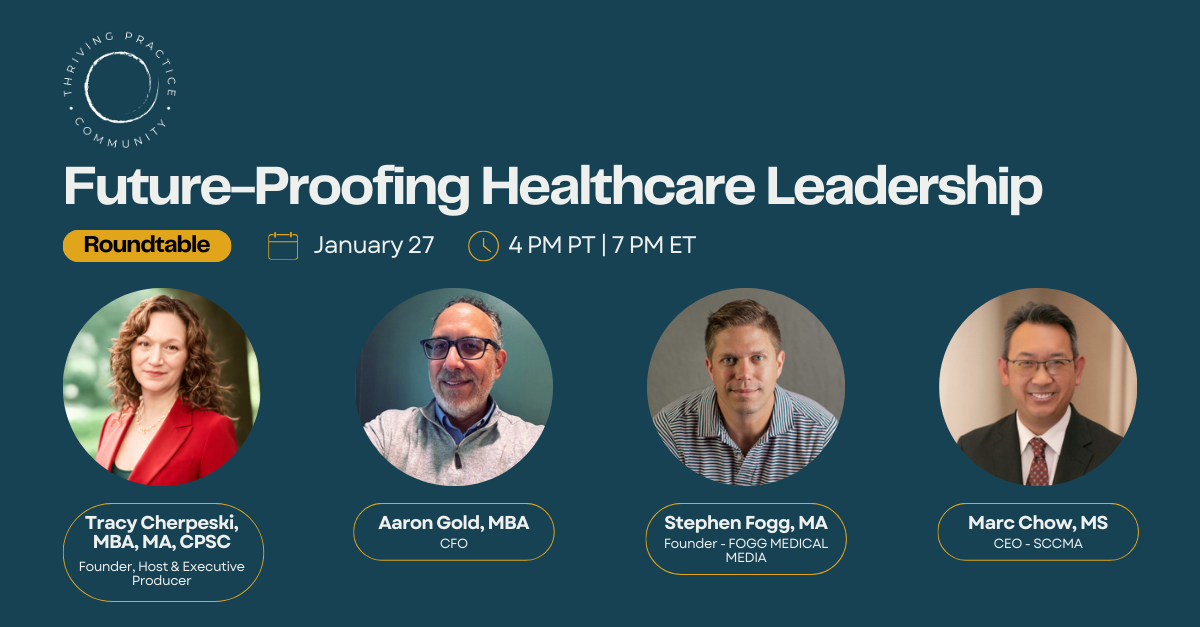
On January 27, we brought together three expert practitioners for a 90-minute virtual roundtable on Future-Proofing Healthcare Leadership in 2026. We had 12 engaged healthcare leaders join us live, and the conversation that unfolded was exactly what I'd hoped for - practical, honest, and immediately actionable.
Here's what we discovered together.
The Forces Reshaping Healthcare Don't Exist in Isolation
I invited Marc Chow, CEO of Santa Clara County Medical Association, Aaron Gold, fractional CFO and financial strategist, and Stephen Fogg, founder of Fogg Media, to discuss three critical areas: policy and regulatory shifts, financial sustainability, and AI innovation.
What became clear within the first 30 minutes is that these forces amplify each other in ways most strategic plans completely miss.
Policy Is No Longer Background Noise
Marc opened with something that hit hard: "Policy is no longer background noise. It's operational reality."
He walked us through what's coming with Medicaid cuts under HR1 - 20% of enrollees (15 million people in California alone) losing coverage. That's not a policy problem. That's a "who shows up to your office, how sick are they when they arrive, and how much uncompensated care are you absorbing" problem.
The prior authorization crisis he described was sobering: 43 prior authorizations per week consuming 10-12 staff hours, 78% of patients abandoning treatment, 95% of physicians reporting burnout. These aren't statistics - these are people's daily reality.
But Marc also shared hope. Creative local solutions like Santa Clara County's Measure A (a 5/8% sales tax providing $330M toward healthcare shortfalls) show that communities recognize healthcare impacts everyone. And the West Coast Health Alliance forming across 16 states demonstrates that when federal guidance falters, regional collaboration can fill the gap.
His advice? Document your baseline now. Track your Medicaid patient mix, uncompensated care levels, and prior authorization burden. These numbers become your most powerful advocacy tool.
Financial Pressure Demands New Frameworks
Aaron translated Marc's policy insights into financial reality: "If you don't know your profitability per patient type, you don't know where you're vulnerable."
Most practice owners know their overall revenue. What they don't know is which patient segments are actually sustainable. When policy shifts change your mix - more Medicaid patients losing coverage, more uncompensated care, more administrative burden - that blind spot becomes a crisis.
Aaron walked us through three critical areas every practice needs to monitor:
Revenue per patient type - segment by Medicare, Medicaid, commercial insurance, cash pay
Overhead analysis - subscriptions, services, recurring costs where blind spots hide
Strategic cash reserves - building a buffer for payment delays and coverage losses
One attendee messaged shared: "I've had my practice for 10+ years and never segmented patient types and revenue this way. I’ll be doing it this week."
That's the kind of immediate action we want to see.
Innovation Levels the Playing Field
Stephen opened with a timeline that shocked people: "12 months ago, everyone said 'we can't use AI because of HIPAA.' Today, 100% of my clients use at least Copilot, most use AI scribes, and tools advance weekly."
The barrier dissolved. The question is no longer "can we?" but "which tools solve our biggest pain points?"
Stephen shared his four-quadrant framework for implementation: Draw four boxes labeled "great," "good," "could improve," and "bad." Focus your first AI tool on whatever's in the "bad" quadrant. For some practices, that's documentation burden (AI scribes). For others, it's marketing (82-86% of patient journeys start online, and small practices can now compete with large systems' digital presence).
The key insight? AI doesn't replace humans - it restores human connection. Physicians who went from 15-minute visits down to 3 minutes due to EMR documentation are now getting that time back with patients. Staff handling repetitive tasks (scheduling, refills, insurance verification) can focus on work requiring human judgment.
But Stephen was clear: tools without training are useless. You need champions, not just seat licenses.
The Pattern We All Need to See
About 45 minutes into the conversation, I paused to name what I was seeing: These three forces don't just coexist - they amplify each other.
Policy creates financial pressure. Financial pressure demands innovation. Innovation requires regulatory navigation.
Most strategic plans have a policy section, a finance section, an innovation section. But they're written as if these operate independently. They don't. They cascade, they compound, they create effects leaders don't anticipate because they're planning in silos.
The leaders in our conversation got it immediately. One participant wrote in chat: "This is the first time I've seen how these pieces actually fit together."
What I Learned Facilitating This Conversation
I've been working with healthcare leaders for almost 16 years. I thought I understood how policy, finance, and innovation intersect. But listening to Marc, Aaron, and Stephen talk through real examples - and watching our attendees connect dots in real-time - deepened my own understanding.
The leaders who will thrive in 2026 aren't the ones with the most resources. They're the ones who see patterns, who understand how external forces amplify each other, who build strategic plans accounting for interconnection rather than hoping things work out.
They're also the ones who know they don't have to do this alone. Every attendee who asked a question, every person who implemented an action step this week, every practice owner who reached out afterward to book a strategy call - they all recognized that isolation is a choice, not a requirement.
Where We Go From Here
We captured the key insights and action steps in a comprehensive highlights document you can download along with the full replay. Whether you attended live or are discovering this conversation now, the insights are immediately applicable.
Here's what to do next:
Watch the replay and take notes on what's most relevant to your situation
Implement at least one action step this week - document your baseline, segment your revenue, or draw your four-quadrant framework
Share this with a colleague who's wrestling with 2026 planning
And if you're thinking "I see the pattern, but I don't know how to translate this into my strategic plan" - that's exactly the conversation we should have. Book a 30-minute strategy call and let's look at your specific situation.
Access the replay and highlights document here.
I'm already planning our next roundtable for early May - different topic, different expert panel, same practical format. If you want to be notified when registration opens, make sure you're on our email list.