

Consistent Marketing Over Perfect Campaigns: Growing Your Practice Without Overwhelm Featuring Kurt Hoffmann, EP 236
Marketing your healthcare practice doesn't require expensive campaigns or overwhelming social media strategies. In this episode, Kurt Hoffmann, founder of Abra Marketing, explains why consistent, authentic marketing is part of your mission as a healthcare provider—and how to make it manageable when you're already stretched thin.
Marketing your healthcare practice doesn't have to mean expensive campaigns or overwhelming social media strategies. In this episode, Kurt Hoffmann, founder of Abra Marketing, shares why consistent, authentic marketing is actually part of your mission as a healthcare provider—and how to make it manageable even when you're already stretched thin.
See Where Your Practice Stands: Take our Practice Growth Readiness Assessment
If you've been struggling with time management for healthcare practice owners while trying to grow your patient base, this conversation offers a refreshing perspective. Kurt explains why running a profitable medical practice starts with understanding that your patient experience is your marketing, and why the practices that thrive are the ones that show up consistently in their communities, not the ones that launch big campaigns and disappear.
Whether you're wondering how to run a successful medical practice without burning out or looking for practical strategies to grow your practice in a sustainable way, Kurt's insights on storytelling, community connection, and realistic marketing programs will help you move forward with confidence.
Key Takeaways
Marketing is mission-driven work: Healthcare providers have a responsibility to close the gap between people suffering and the solutions that can help them
Consistency beats perfection: Showing up monthly with something simple outperforms sporadic big campaigns
Your patient experience IS your brand: Marketing doesn't start with ads—it starts the moment a patient tries to contact your practice
Focus creates opportunity: Marketing one specific service doesn't limit your other offerings; it creates a gateway for patient relationships
Human connection is your competitive advantage: In an AI-driven world, practices that prioritize real human interaction stand out
Q&A
Why do healthcare practices need marketing? Because we live in a world of imperfect information. People in your community may be suffering not because solutions don't exist, but because they don't know about them or don't know where to find help. Marketing closes that gap between patient needs and provider solutions.
What's the biggest mistake practice owners make with marketing? Feeling overwhelmed and doing nothing, or launching big campaigns that aren't sustainable. The most successful marketing programs are consistent, modest efforts every single month—not occasional big splashes followed by months of silence.
How much should patient experience factor into marketing strategy? Patient experience IS marketing. Your brand isn't your logo—it's what everyone thinks and feels about your practice. If you're getting negative reviews about front desk interactions, no amount of advertising will overcome that. Start by looking at the complete patient journey from first contact through follow-up care.
Can I market a specific service without losing patients for other services? Absolutely. Focusing your marketing on one signature service or procedure creates a gateway for patient relationships. Once someone has a great experience with you for one service, they become both repeat clients for other needs and referral sources for friends and family.
Episode Highlights
Kurt's origin story: from healthcare marketing to the music industry and back again, with fresh perspective
The question that shaped his career: "Why do we need marketing?" from a chief of staff in his first weeks on the job
How Abra Marketing turned a martial arts school's story into a 30-minute documentary that changed their reputation in the Bay Area fight community
Why lighting a bridge pink for breast cancer awareness drew thousands and became a game-changing community event
The tracking study that revealed huge volumes of appointments come from repeat business and referrals—proving that every new patient opens a pipeline of future business
Practical advice on responding to negative reviews in ways that actually improve your reputation
Why practice owners should look for 2-3 marketing channels that feel natural rather than trying to be everywhere
The shift toward human connection as a differentiator in an increasingly automated world
Memorable Quotes
"We live in a world of imperfect information. You can't assume that people know about all the cures that are out there for the things they're suffering from. That is why I love marketing—we close that gap."
"Your brand is not your logo and your name. Your brand is what everybody thinks about your practice. So start with taking a hard look at why do people love your practice and what could be some things working against you that you could fix."
"The best marketing programs are just consistent—being out there every month doing something—versus a huge project where you do this big splash and then you don't do anything for months."
"You have a mission to market. A lot of people are suffering not because there's not a solution to what's ailing them, but they don't have the information of who can help them or that there is a new solution that can quickly help them."
"Someone's life is better because of you. That's our tagline, and it honors the important work that providers do. Our role is to close that gap and help you tell your story to the people who need to hear it."
Internal Linking Opportunities
When discussing time management and feeling overwhelmed: "Just as we teach practice owners about time leadership strategies for managing admin work, effective marketing requires the same principle—doing fewer things consistently rather than everything sporadically."
In the section about patient experience: "This connects directly to what we discussed in Episode on practice operations and patient satisfaction about how every touchpoint matters in building your practice reputation."
Healthcare marketing doesn't have to be complicated or overwhelming. Start with what Kurt calls the mission to market—remembering that consistent, authentic connection with your community helps patients find the care they need. Pick one or two channels that feel natural, show up every month, and tell your story. Your patient experience is your brand, and your willingness to connect on a human level is becoming your biggest competitive advantage.
Ready to build a marketing strategy that aligns with your practice values and actually fits into your schedule? Visit PracticeSuccess.co/resources for tools and frameworks designed specifically for independent practice owners.
Guest Bio:
Kurt Hoffmann has worked in healthcare marketing since the 1990s.
Kurt founded Abra Marketing in 1999 and has since competed hundreds of healthcare
marketing projects for global healthcare companies such as Medtronic and Smith+Nephew as well as local practices/hospitals and clinics.
Abra’s strength is digital marketing programs that help local practices and providers connect with the patients they can help.
Find Kurt:
See Where Your Practice Stands: Take our Practice Growth Readiness Assessment
Connect With Us:
Three Healthcare Experts, One Solution: How to Future-Proof Your Practice When Everything Feels Urgent, EP 235
In this episode, Tracy breaks down her recent "Future-Proofing Healthcare Leadership in 2026" roundtable featuring Marc Chow (CEO of Santa Clara County Medical Association), Aaron Gold (strategic CFO), and Stephen Fogg (healthcare marketing strategist and AI innovation specialist). Despite approaching practice management from completely different angles - policy, finance, and innovation - all three experts confirmed the same fundamental truth about how to actually move forward when the ground keeps shifting.
What happens when a Silicon Valley policy leader, a strategic CFO, and an AI innovation specialist walk into a roundtable about healthcare leadership? They all arrive at the exact same conclusion - independently. And it's the framework Tracy has been teaching practice owners for years.
In this episode, Tracy breaks down her recent "Future-Proofing Healthcare Leadership in 2026" roundtable featuring Marc Chow (CEO of Santa Clara County Medical Association), Aaron Gold (strategic CFO), and Stephen Fogg (healthcare marketing strategist and AI innovation specialist). Despite approaching practice management from completely different angles - policy, finance, and innovation - all three experts confirmed the same fundamental truth about how to actually move forward when the ground keeps shifting.
See Where Your Practice Stands: Take our Practice Growth Readiness Assessment
If you're feeling overwhelmed by everything coming at you in 2026, this episode gives you permission to simplify. Because complexity isn't your problem - trying to solve everything at once very likely is.
Key Takeaways
The expert consensus: Three heavyweight experts from different domains independently confirmed the same approach - choose what needs the most work, break it down to a simple implementable task, build from there
Policy reality check: Track your baseline on pain points like Medicaid patient volume, uncompensated care, and prior authorization hours before trying to solve the entire system
Financial clarity: Start with one metric - revenue per patient - then segment by patient type to understand which segments are actually sustainable
Innovation without overwhelm: Use Stephen Fogg's four-quadrant framework (great, good, could improve, bad) to identify your worst pain point, then implement ONE tool to address it
The methodology works: Whether you're navigating policy chaos, financial pressure, or innovation overwhelm, the solution is the same - start with one thing, make it implementable, build momentum
Q&A Section
How do you choose what to prioritize when everything feels urgent in your practice? Use Stephen Fogg's four-quadrant assessment: categorize what's great, good, could improve, and bad in your practice. Then focus on fixing your biggest "bad" first - not trying to improve everything simultaneously.
What's the one financial metric practice owners should track closely right now? Revenue per patient. Start broad, then break it down by patient type (Medicare, Medicaid, commercial, cash pay) to understand which segments are profitable. If policy shifts your patient mix, you need to know if that mix is sustainable.
How does the Time Leadership Framework connect to managing policy, finance, and innovation pressures? Both approaches solve for the same problem: how to choose what matters when everything feels urgent. The framework helps you decide what needs your clinical expertise, what can be delegated, what can be systematized, and what can be eliminated - so you're not trying to do everything at once.
What's the first step to take when prior authorizations are burning out your staff? Document your baseline first. Track exactly how many hours per week your staff spends on prior authorizations. That documentation becomes your advocacy ammunition and helps you make the business case for solutions.
Episode Highlights
Why three healthcare experts from different domains all arrived at the same fundamental conclusion about managing overwhelm
The forces reshaping healthcare in 2026: Medicaid cuts affecting 20% of enrollees, prior authorization consuming 10-12 staff hours weekly, and trust erosion in public health institutions
Marc Chow's policy perspective: Start by documenting one pain point this week - not solving the entire system
Aaron Gold's financial strategy: Understanding which patient segments are actually profitable before policy shifts your mix
Stephen Fogg's innovation framework: The four-quadrant assessment for identifying where your practice is hurting most
The AI implementation trap: Why teams get Copilot licenses, nobody gets trained, nobody uses it, and money gets wasted
How Stephen's quadrant framework maps directly onto the Time Leadership Delegation Quadrant
Why complexity is the enemy of implementation - and what to do about it
The validation piece: When independent experts confirm the same methodology from different angles
Memorable Quotes
"Complexity isn't your problem. Trying to solve everything at once very likely is."
"Most practice owners I work with aren't failing because they don't know what needs to be done. They're failing because they're trying to do ALL of it at once."
"You don't need more information. You need clarity on what to prioritize and a simple next step you can actually take."
"Whether the ground is shifting beneath you because of policy changes, financial pressure, or innovation demands - the solution is the same: Start with one thing. Make it simple. Make it implementable. Build momentum."
"Complexity is the enemy of implementation."
Resources Mentioned in This Episode
Future-Proofing Healthcare Leadership in 2026 Roundtable Replay - Full 90-minute recording with Marc Chow, Aaron Gold, and Stephen Fogg. Request the replay and highlights document.
Time Leadership Delegation Quadrant - Tracy's framework for deciding what needs your expertise, what to delegate, systematize, or eliminate. Click to request.
Future-proofing your practice in 2026 doesn't mean mastering policy, finance, and innovation simultaneously. It means choosing the one thing causing the most pain right now, taking the simplest first step this week, and building momentum from there. When three experts from completely different domains independently confirm the same approach, that's not coincidence - that's validation of what actually works when you're navigating uncertainty.
Ready to apply this framework to your specific situation? Book a strategy call with Tracy at TracyCherpeski.com to talk through your priorities and build your implementation plan.
See Where Your Practice Stands: Take our Practice Growth Readiness Assessment
Tracy’s Bio:
Tracy Cherpeski, MBA, MA, CPSC (she/her/hers) is the Founder of Tracy Cherpeski International and Thriving Practice Community. As a Business Consultant and Executive Coach, Tracy helps healthcare practice owners scale their businesses without sacrificing wellbeing. Through strategic planning, leadership development, and mindset mastery, she empowers clients to reclaim their time and reach their potential. Tracy designs and delivers CME-accredited wellness retreats and workshops in partnership with medical associations, bringing burnout prevention and sustainable practice management to physicians nationwide. Based in Chapel Hill, NC, Tracy serves clients worldwide and is the Executive Producer and Host of the Thriving Practice podcast. Her guiding philosophy: Survival is not enough; life is meant to be celebrated.
Connect With Us:
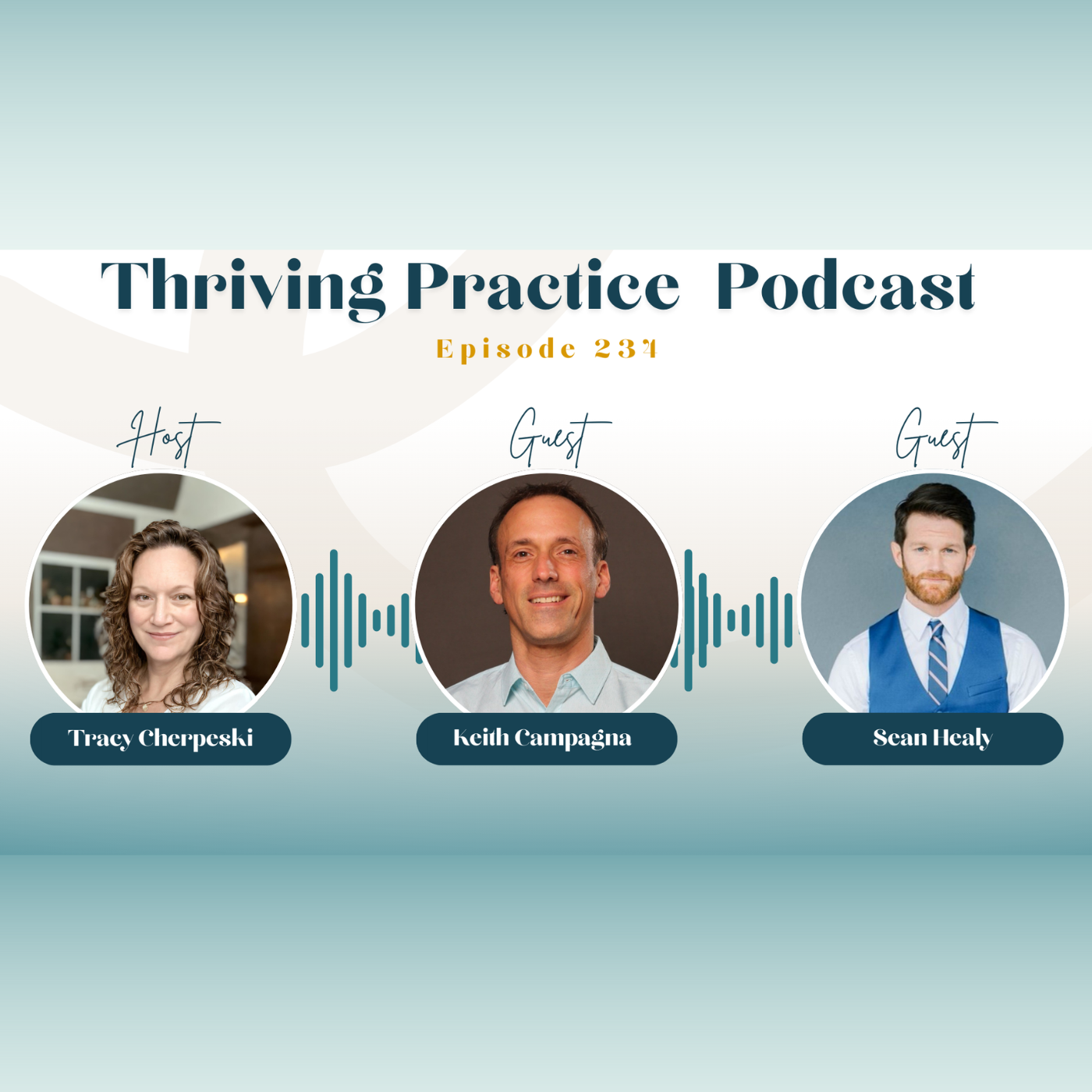
"Am I Actually Making Money?" Understanding the Numbers That Matter Most in Private Practice Featuring Sean Healy and Keith Campagna, EP 234
Running a profitable medical practice requires more than clinical excellence—it demands financial clarity that most healthcare providers were never trained to achieve. Many practice owners find themselves caught in a frustrating paradox: their accountant tells them they're profitable, yet their bank account tells a different story. Cash flow problems persist, credit card debt grows, and the question "am I actually making money?" remains unanswered.
Running a profitable medical practice requires more than clinical excellence—it demands financial clarity that most healthcare providers were never trained to achieve. Many practice owners find themselves caught in a frustrating paradox: their accountant tells them they're profitable, yet their bank account tells a different story. Cash flow problems persist, credit card debt grows, and the question "am I actually making money?" remains unanswered.
In this episode, Tracy sits down with Sean Healy and Keith Campagna from Accounted For LLC to explore the critical difference between cash flow and profitability, and why understanding both is essential for building a thriving practice without burnout. Sean and Keith have spent seven years developing a comprehensive approach that goes far beyond traditional bookkeeping to include insight extraction and strategic coaching specifically designed for private practice owners.
Is your practice growth-ready? See Where Your Practice Stands: Take our Practice Growth Readiness Assessment
Whether you're struggling with time management for healthcare practice owners, trying to build a profitable medical practice, or simply want to run a successful medical practice without the constant financial stress, this conversation offers practical frameworks and strategic guidance you can implement immediately.
Key Takeaways
The cash flow vs. profitability gap is real: Most accountants focus on profitability for tax purposes, but practice owners operate in cash flow reality—understanding the difference is crucial for making sound business decisions.
Hope is not a strategy: While gut instincts are often correct, running "napkin math" before major decisions helps validate or challenge assumptions and prevents costly mistakes.
Three-part approach to financial clarity: Effective financial management requires data management, insight extraction from that data, and coaching to take action on those insights.
You're not alone in this struggle: The challenges you face as a practice owner are systemic across the industry—asking for help is a strategic advantage, not a weakness.
Goals must be quantified: Knowing you need 20% profit isn't enough—you need to know exactly what profit level gets you to your specific retirement and lifestyle goals, then work backward from there.
Q&A
Why do practice owners struggle to understand if they're actually making money? Most accountants present profitability (which drives tax liability), while business owners operate in cash flow reality. This creates a significant disconnect where someone can be "profitable" on paper while struggling to make payroll or watching credit card debt increase. The two metrics tell different but equally important stories about practice health.
What makes Accounted For LLC different from traditional bookkeeping services? While traditional accounting firms manage data to file tax returns, Accounted For LLC manages data to extract insights, then provides coaching to help practice owners take action on those insights. Their approach combines financial analysis with accountability and strategic guidance specifically tailored to private practice ownership challenges.
How much profit does a practice actually need to be successful? The answer isn't a generic percentage—it's however much profit you need to achieve your specific goals. Most practice owners say 20%, but the real question is: have you quantified your retirement goals, lifestyle needs, and legacy objectives? Once you know those numbers, you can determine if your current business model will get you there or if significant changes are needed.
What's the first step practice owners should take to gain financial clarity? Start with a complimentary financial analysis to understand what story your numbers are telling. Getting a second set of eyes on your financials—and slowing down to truly understand cash flow versus profitability—can reveal opportunities you're missing and help you make more informed strategic decisions.
Episode Highlights
The origin story of Accounted For LLC and the simple question that started everything: "Am I making money?"
Understanding why healthcare training creates a psychological barrier to asking for help with business challenges
The bow and arrow analogy: how financial clarity acts like a laser sight for hitting your business targets
Why "slowing down to speed up" is essential before making major business decisions
The three components of effective financial management: data, insights, and coaching
How capacity and goal-setting can transform practice performance without additional hiring costs
The importance of weekly strategic partnerships and peer networks for business owners
Why most practice owners' gut instincts are correct—they just need validation through the numbers
Memorable Quotes
"Hope's not a strategy." - Sean Healy
"You're not alone. The same trend is there. They feel like they're alone, but they're not... Ask for help and you'll feel better sooner." - Keith Campagna
"All change starts with self awareness." - Sean Healy
"Does this mean I'm going to sleep better? That was all she needed to ask." - Keith Campagna (sharing a client's response after their financial assessment)
"Prescription before diagnosis is malpractice. That applies to business too." - Sean Healy
The journey from wondering "am I making money?" to confidently leading a profitable practice starts with asking for help and gaining clarity on what your numbers are actually telling you. Sean and Keith remind us that the struggles practice owners face aren't unique—they're systemic across the industry—but the solutions become clearer when you have the right partners and tools in place. Whether you need a comprehensive financial partnership or simply want a second set of eyes on your current situation, taking that first step toward financial clarity can transform not just your business outcomes, but your sleep quality and overall wellbeing.
Guest Bios:
Sean Healy and Keith Campagna are the driving forces behind Accounted For LLC, a financial services company built specifically for private practice owners who need more than traditional bookkeeping. Founded seven years ago from a single client question—"Am I actually making money?"—Accounted For bridges the gap between profitability and cash flow with CFO-level insights at a fraction of the typical cost.
Their approach combines three essential elements: data management, insight extraction, and strategic coaching. Whether you're struggling with cash flow, planning to scale and grow your practice, or simply want to make informed decisions with your money, Accounted For uses your accounting data as a platform to provide actionable perspective. Their proactive, outcomes-driven methodology helps practice owners focus on what matters most while gaining the financial clarity needed to sleep better at night.
Accounted For offers a complimentary financial analysis to any practice owner who wants to understand what story their numbers are telling. This no-obligation assessment often reveals money being left on the table and provides insights you can keep regardless of whether you choose to work together.
Find Sean & Keith:
Inquire: email Keith kcampagna@accounted4llc.com
See Where Your Practice Stands: Take our Practice Growth Readiness Assessment
Connect With Us:
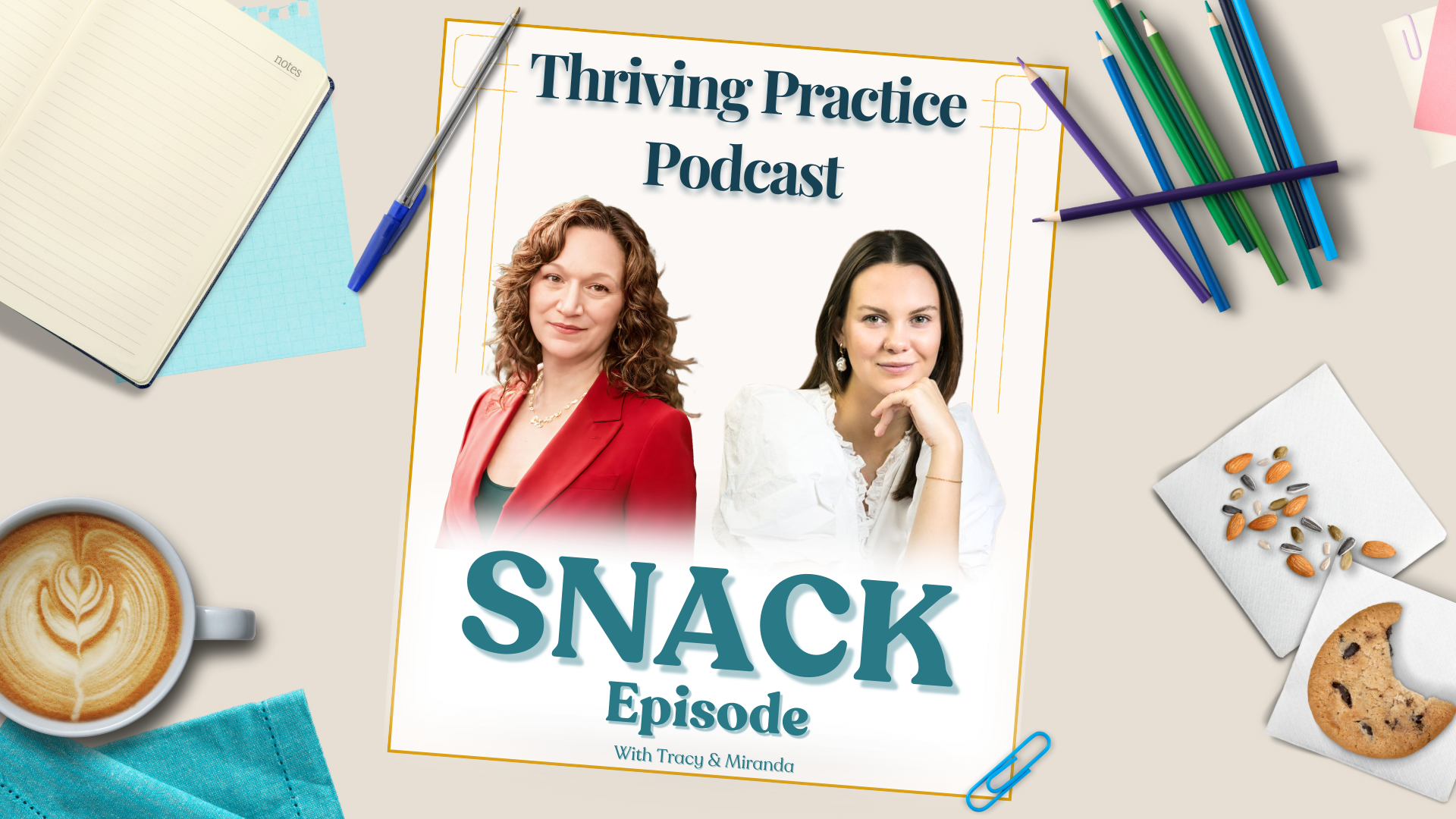
The Multiplier Mindset: Why Subtracting Is the Key to Practice Growth – A Special Snack Episode, EP 233
More than half of healthcare practice owners report burnout, and the traditional response—working harder, seeing more patients, adding more services—keeps them trapped in a cycle that never delivers the freedom they imagined. In this SNACK episode, Miranda Dorta interviews Tracy about the 10x practice owner mindset and why sustainable practice growth requires subtraction, not addition.
If you're a healthcare practice owner working harder than ever but still feeling stuck, you're not alone. More than half of practice owners report burnout, and most respond the same way: seeing more patients, adding services, extending hours. But what if the path to practice growth and freedom isn't about doing more—it's about doing less?
In this SNACK episode, Miranda Dorta turns the microphone on Tracy to explore the 10x practice owner mindset framework. This isn't about working 10 times harder or even necessarily earning 10 times more revenue. It's about asking fundamentally different questions that shift you from operator to owner.
Tracy shares why the biggest obstacle to sustainable practice growth is often a single belief: that you're responsible for doing everything. Even practice owners with capable teams and solid delegation systems hit invisible ceilings because of this mindset. The solution? Learning to subtract in order to multiply.
Key Takeaways
The core problem: Practice owners stay stuck when they believe they must personally handle everything, even with capable teams in place
10x thinking means subtraction: Ask "What would I need to subtract in order to multiply?" rather than automatically adding more
The multiplier mindset test: If you could only work 2-3 days a week, would your practice continue to grow? If not, you're still in operator mode
Focus on what only you can do: The highest-value use of your time is activities that require your specific expertise, credentials, or unique skills
The smallest shift creates the biggest ripple: Getting curious about how things could be different if you didn't have your hands on everything is the starting point for real change
Questions Answered in This Episode
What keeps practice owners stuck on the hamster wheel? The biggest driver is believing you're responsible for doing everything in your practice. Even when you have a strong team and have delegated well, there's often still a mindset block that prevents real progress and keeps you in the day-to-day operations rather than leading strategically.
What does 10x thinking actually mean for practice owners? It's not about 10x-ing your effort or necessarily your revenue. It's about asking: "What would it take for this to multiply?" and "What would I need to subtract in order to multiply?" Most practice owners think they need to add more to grow, but sustainable growth often requires removing things that no longer serve your trajectory.
How do I know if I have a multiplier mindset? Ask yourself: "If I could only show up two or three days a week, would the practice continue to grow?" If the answer isn't yes, you're not yet thinking like a multiplier. This question makes every practice owner nervous—even those who intellectually know they should reduce clinical time—but it reveals exactly where the mindset shift needs to happen.
What should I eliminate first when trying to reduce my time in the practice? Start with your clinical load. Look at what's on your clinical calendar that could be handled by someone else on your team. Ask: "What are the activities that only I, the owner, can do?" Tracy shares an example of a board-certified psychologist who eliminated routine ADHD screenings to focus exclusively on high-level DOJ and Department of Corrections cases that required her specific certification. She reduced clinical time while maintaining billable hours by focusing on what only she could do.
Episode Highlights
The "do everything" belief that keeps practice owners trapped in operator mode
Why sustainable growth requires subtraction, not addition—and what that looks like in practice
The multiplier mindset test: Could your practice grow if you only worked 2-3 days a week?
Real example: How a psychologist maintained revenue while working less by focusing on high-level cases
Constraint-based thinking: Using time limitations as a strategic tool for growth
Why every practice owner feels fear around letting go (and why you should do it anyway)
The physical responses you might experience when doing this mindset work
How to identify which systems need attention and which activities require your unique expertise
The importance of backup systems so you're never hamstrung by a single point of failure
The smallest mindset shift that creates the biggest ripple effect in your practice
Memorable Quotes
"What would I need to subtract in order to multiply? A lot of times we think we need to add in order to multiply."
"If I could only show up two or three days a week, would the practice continue to grow? And if the answer is not yes to that, then they're not in a multiplying mindset."
"What are the activities that only I, the owner, can do? That's where your time should go."
"You don't have to let go of the fear—I think you just do it scared. But you have to trust the process."
"Just start to get a little bit more comfortable with the idea of your hands not touching every single process. Just imagine it. You don't have to do anything about it yet."
The path to a thriving practice isn't paved with longer hours and more hustle. It's built on strategic thinking, intentional subtraction, and the willingness to let go of control—even when it feels uncomfortable. If you're ready to shift from working in your practice to leading it, start by getting curious about how things could be different if you weren't touching every single process.
Ready to develop your multiplier mindset? Visit thrivingpracticecommunity.com to schedule a consultation with Tracy and learn how to build a practice that grows without burning you out.
Is your practice growth-ready? See Where Your Practice Stands: Take our Practice Growth Readiness Assessment
Miranda’s Bio:
Miranda Dorta, B.F.A. (she/her/hers) is the Manager of Operations and PR at Tracy Cherpeski International. A graduate of Savannah College of Art and Design with expertise in writing and creative storytelling, Miranda brings her skills in operations, public relations, and communication strategies to the Thriving Practice community. Based in the City of Oaks, she joined the team in 2021 and has been instrumental in streamlining operations while managing the company's public presence since 2022.
Tracy’s Bio:
Tracy Cherpeski, MBA, MA, CPSC (she/her/hers) is the Founder of Tracy Cherpeski International and Thriving Practice Community. As a Business Consultant and Executive Coach, Tracy helps healthcare practice owners scale their businesses without sacrificing wellbeing. Through strategic planning, leadership development, and mindset mastery, she empowers clients to reclaim their time and reach their potential. Tracy designs and delivers CME-accredited wellness retreats and workshops in partnership with medical associations, bringing burnout prevention and sustainable practice management to physicians nationwide. Based in Chapel Hill, NC, Tracy serves clients worldwide and is the Executive Producer and Host of the Thriving Practice podcast. Her guiding philosophy: Survival is not enough; life is meant to be celebrated.
Connect With Us:
Schedule Strategy Session with Tracy
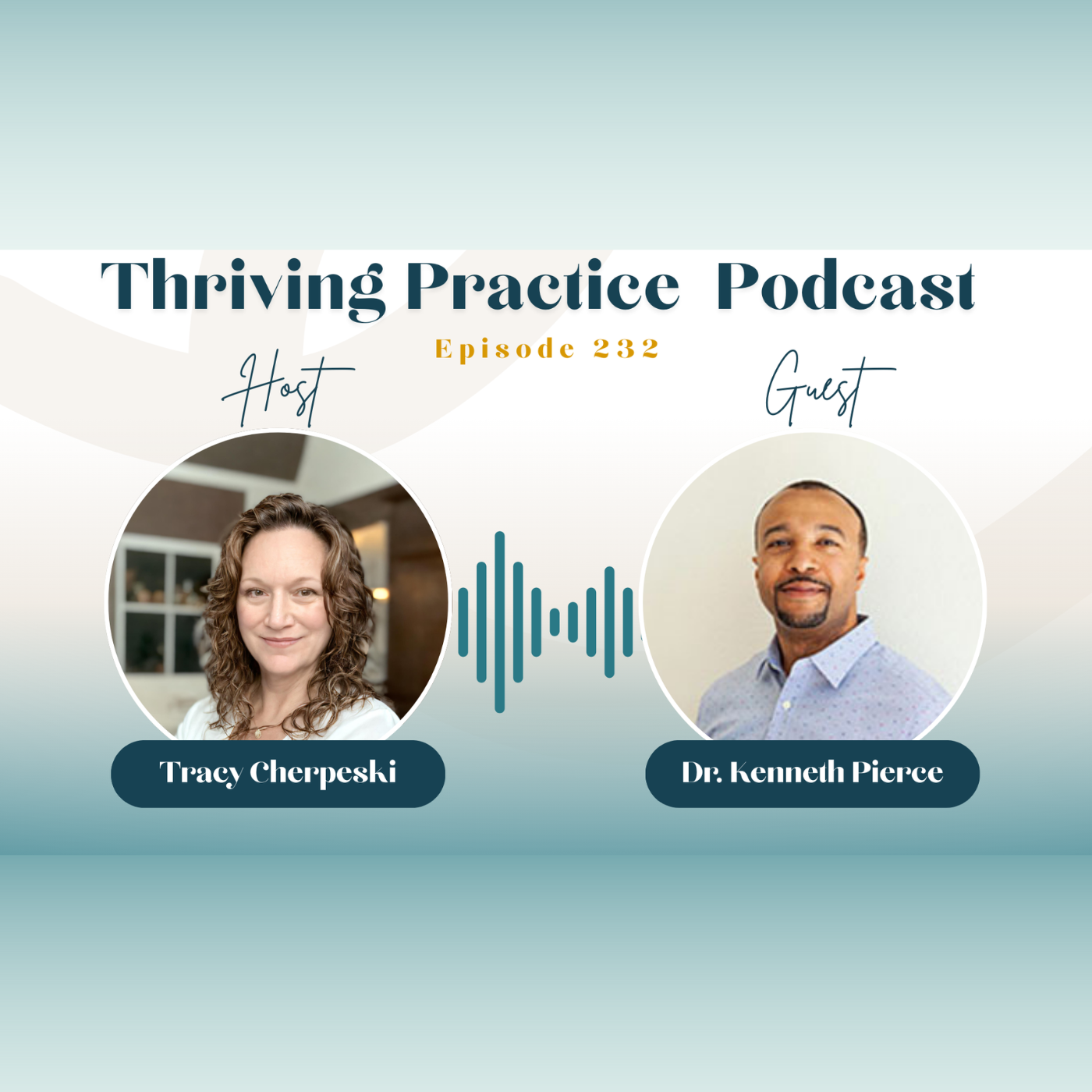
Bridging the Specialist Gap: How Virtual Consultations Transform Veterinary Practice Management Featuring Dr. Kenneth Pierce, EP 232
Dr. Kenneth Pierce shares how virtual specialist consultations improve veterinary practice management, patient outcomes, and prevent burnout for practice owners.
When Dr. Kenneth Pierce opened Veterinary Vision Center in Shreveport, Louisiana, he became the first permanent veterinary ophthalmologist in a region where pet owners had been driving three to four hours for specialty eye care. But addressing that local gap led him to recognize a much larger systemic problem: the nationwide shortage of veterinary specialists creates accessibility challenges that affect patient outcomes, strain general practitioners, and burden pet owners financially.
His solution, Vespecon, offers a scalable model for bridging the specialist gap through virtual consultations that empower general practitioners while improving care. For practice owners in any healthcare specialty looking at how to run a successful medical practice without burning out, Dr. Pierce's approach demonstrates how strategic delegation and access to expert support can transform both clinical outcomes and practice sustainability.
See Where Your Practice Stands: Take our Practice Growth Readiness Assessment
Key Takeaways
The specialist shortage is real and growing: There's a significant gap between the number of general practitioners produced annually and the number of specialists across veterinary medicine—a disparity that will never catch up and leaves large regions underserved
Virtual consultation models work: Unlimited access to face-to-face specialist consultations empowers general practitioners to deliver elevated care locally, improving patient outcomes while reducing costs for pet owners
Trust is the foundation: When veterinarians can confidently say "I've consulted with a specialist, and here's the plan" instead of "I don't know," it strengthens the veterinarian-client relationship and leads to better compliance with treatment recommendations
Asking for support strengthens leadership: Whether it's clinical knowledge or business operations, seeking expert guidance isn't an abdication of responsibility—it's strategic leadership that prevents burnout and improves outcomes
Business support is clinical support: Addressing HR needs, financial planning, and leadership coaching helps practice owners focus on clinical excellence while building sustainable, profitable practices
Q&A
Why do veterinarians need access to specialist consultations? Most veterinary specialists concentrate in metropolitan areas, leaving vast regions of the country without local specialty care. This means pet owners face long drives, high costs, and delays in treatment. General practitioners often lack specialist guidance for complex cases, creating stress and potentially suboptimal outcomes.
How does Vespecon's virtual consultation model work? Veterinary practices can access unlimited face-to-face virtual consultations with specialists across all fields through a membership model. The personal, conversational approach allows specialists to educate and empower general practitioners, confirm they're on the right track, and provide specific guidance—all without the client needing to travel or pay specialist fees directly.
What's the business case for unlimited specialist access? When veterinarians have confidence and specialist backing, they can handle more cases locally, deliver better outcomes, and build stronger client trust. This leads to increased revenue, higher client loyalty, and better practice profitability—while simultaneously improving patient care and reducing costs for pet owners.
How does business advisory support help prevent veterinary practice burnout? Practice owners wear multiple hats—clinician, business owner, strategist, team leader, and more. Having access to HR support, financial advisors, and leadership coaching means they can focus on clinical excellence while experts handle business operations, team culture issues, and crisis management when needed.
Episode Highlights
Dr. Pierce's journey from wanting to be a doctor who didn't work on people to becoming a veterinary ophthalmologist
Why ophthalmology specifically appealed: the eye as a unique organ, microsurgery, and the variety of species
The reality of veterinary specialist shortages and geographic concentration in metropolitan areas
How Vespecon removes the barrier of saying "I don't know" for general practitioners
The uncomfortable reality of financial discussions in veterinary care and how specialist guidance eases that stress
Why asking for business support isn't abdication—it's strategic leadership
The importance of "hat switching" between clinician and business owner roles
Business advisory services including HR, financial guidance, and leadership coaching for veterinary practices
How treating a goldfish's eye problem demonstrates the breadth of veterinary ophthalmology
The ripple effects of better access: improved outcomes, cost savings, reduced stress, and stronger trust
Memorable Quotes
"There's got to be a better way and a more personal approach—specialists you're talking to should be fully invested, not just someone on the other line who may not answer your questions appropriately."
"With the membership, veterinarians have unlimited consultations. We recommend they don't even charge the client for that. Get the knowledge, deliver that elevated level of pet care, and clients will spend more money, be more loyal, and you'll have better patient outcomes."
"The vulnerability of saying 'I don't know' is taken away. That barrier is gone. Veterinarians have access, they can do more, and they prove themselves as stellar veterinarians—they just need a little guidance, not being a specialist."
"Asking for support and accepting support is not an abdication of your responsibility as a business owner and as a leader. It's actually a sign of strength that supports your leadership."
"You gotta lighten your load. You got enough stuff on your plate already. Life doesn't stop happening when we go to work, and if we own a business, it doesn't stop happening when we leave the building either."
Whether you're a veterinarian, physician, dentist, or any other healthcare practice owner, Dr. Pierce's model offers valuable lessons about identifying systemic gaps and creating solutions that serve everyone in the care continuum. The principle applies universally: when you remove barriers to knowledge, empower practitioners with expert support, and address both clinical and business needs holistically, you create sustainable practices that prevent burnout while improving patient outcomes. If you're ready to explore how strategic support can transform your practice, join the Thriving Practice Community where we help independent practice owners build profitable, sustainable businesses without sacrificing their wellbeing.
Guest Bio:
Dr. Kenneth Pierce is a native New Orleanian. He received his undergraduate degree from Tuskegee University and his Doctorate of Veterinary Medicine from Louisiana State University’s School of Veterinary Medicine. He completed a small animal medicine and surgery internship at the University of Tennessee’s College of Veterinary Medicine and then traveled to Southern California to complete a specialty ophthalmology internship with Eye Care for Animals and B. Braun, Inc. He then completed a four-year comparative ophthalmology residency with a master’s degree at Michigan State University. Dr. Pierce started as an Associate Professor at LSU’s School of Veterinary Medicine and then transitioned to private practice at Garden State Veterinary Specialists in Tinton Falls, NJ, Veterinary Eye Institute, in Plano, TX, and then started his own business, Veterinary Vision Center, in Shreveport, LA. After experiencing and working in an underserved area with limited access to veterinary specialty care, Dr. Pierce started VESPECON, a veterinary specialist to primary veterinarian advisory support, concierge referral service, and more! As you can see, Dr. Pierce has lived in every region of the United States and has gained valuable experience to educate and empower the veterinary community.
Find Dr. Pierce:
See Where Your Practice Stands: Take our Practice Growth Readiness Assessment
Connect With Us:
The Three-Year Journey: How One Physician's Burnout Led to Helping Others Reconnect Featuring Dr. Shelina Jaffer, EP 231
Dr. Shelina Jaffer's burnout didn't announce itself with fanfare. Like so many physicians managing demanding practices, she normalized the warning signs—gastritis, reflux, exhaustion—until her body forced a reckoning with late-onset asthma and a moment of emotional darkness she couldn't explain away. Her story is textbook physician burnout, yet her response was anything but typical. Instead of simply stepping away from a toxic role, Shelina embarked on a three-year journey of self-discovery that led to the creation of Haven Within, a program helping healthcare professionals reconnect with their inner wisdom before burnout takes hold.
Dr. Shelina Jaffer's burnout didn't announce itself with fanfare. Like so many physicians managing demanding practices, she normalized the warning signs—gastritis, reflux, exhaustion—until her body forced a reckoning with late-onset asthma and a moment of emotional darkness she couldn't explain away. Her story is textbook physician burnout, yet her response was anything but typical. Instead of simply stepping away from a toxic role, Shelina embarked on a three-year journey of self-discovery that led to the creation of Haven Within, a program helping healthcare professionals reconnect with their inner wisdom before burnout takes hold.
In this episode, Shelina shares how she moved from acute medicine and general practice in the UK through the classic progression of burnout—taking work to weddings in Canada, explaining away physical symptoms, operating on autopilot until her body said enough. But the real story begins with her recovery: how immediately her symptoms improved when she changed roles, and how that shift opened space for deeper questions about identity, purpose, and what it means to thrive rather than simply survive in healthcare.
Today, Shelina works with organizations, universities, and individuals through Haven Within, facilitating experiential sessions focused on four key stages: discovering who you are through others' eyes, exploring your values, identifying limiting beliefs, and connecting with your deeper purpose. Her work addresses something fundamental that traditional wellness programs miss—respect, trust, and the simple act of slowing down to reconnect with yourself.
Is your practice growth-ready? See Where Your Practice Stands: Take our Practice Growth Readiness Assessment
Key Takeaways
Classic burnout progression often looks like being a "good, hard worker" until physical symptoms force recognition
Changing work environments can produce immediate physical relief, but full recovery takes time (Shelina's took three years)
Organizational culture built on respect and trust increases innovation, creativity, and productivity—not just employee wellbeing
Experiential learning that challenges participants to examine blind spots and limiting beliefs creates lasting shifts that 90-minute workshops cannot achieve
The shift toward human-centered approaches in healthcare is happening universally, driven by collective recognition that current systems are unsustainable
Q&A Section
What are the early warning signs of physician burnout that get normalized? Taking work home regularly (even to vacations), dismissing new physical symptoms as "just stress" or aging, and experiencing emotional flatness or darkness during patient interactions. These behaviors often look like dedication and professionalism, which is why burnout progression can be so insidious in healthcare.
How long does recovery from advanced burnout actually take? While symptoms may improve immediately upon changing work environments, full recovery takes considerably longer. Dr. Jaffer's experience shows that genuine healing and rebuilding capacity took three years—a timeline that challenges the quick-fix mentality often applied to burnout solutions.
Why do organizations resist investing in team wellbeing programs? Many leaders operate under the false assumption that prioritizing respect, trust, and work-life balance conflicts with financial success. However, when teams feel valued and trusted, they contribute more innovation and creativity, ultimately improving organizational outcomes and profitability.
What makes experiential learning more effective than traditional wellness workshops? Experiential programs challenge participants to actively explore their blind spots, limiting beliefs, and values through interactive exercises with peers. This creates personal accountability and insight that passive learning cannot achieve. The work continues beyond the session as participants integrate new awareness into their lives.
Episode Highlights
The textbook progression of physician burnout: from normalizing stress to physical symptoms (gastritis, reflux, late-onset asthma) to emotional darkness
The immediate physical relief Shelina experienced simply by changing to a role without management pressures—highlighting how occupational factors directly impact health
Haven Within's four-stage experiential process: discovering yourself through others' perspectives, exploring values, confronting limiting beliefs, and connecting with purpose
The university student who became bold after one session—demonstrating how early intervention can change career trajectories
Why organizations that prioritize respect and trust see better outcomes: valued teams contribute 200% and bring more innovation
The fundamental simplicity of what's needed: slowing down, connecting with yourself, and creating space to hear your own wisdom
The broader shift happening in humanity toward reconnection with ourselves and each other, away from the edges of our functional capacity
Memorable Quotes
"Everything that looks like being a good hard worker and a contributor and being a great physician is early stage burnout. It's what contributes to the pretty quick acceleration into advanced stages." - Tracy Cherpeski
"I literally walked in, saw my patients, went home, and I was like, wow, okay, I feel okay. It took a while for me to get back to where I am. It's been three years since that happened, and it's only now that I feel like I'm starting to want to do more." - Dr. Shelina Jaffer
"One of the students who was the quietest in the class, his feedback at the end was, 'You have taught me to be bold.' For me, that one statement was enough." - Dr. Shelina Jaffer
"If you respect your team, you trust your team, and they feel valued, they will give 200%. What's more is that they will be more innovative, more creative, and you'll get more out of your organization." - Dr. Shelina Jaffer
"We spend most of our lives in our workplace. Why do we need to be in a space that is weekend mentality? Monday is another beautiful day. If you love your job, why don't you love your job?" - Dr. Shelina Jaffer
If you've been feeling the early whispers of burnout—or if you're already deep in recovery—Shelina's story offers both validation and a path forward. Haven Within reminds us that reconnection with ourselves isn't a luxury; it's essential to sustainable practice and genuine wellbeing. The shift Shelina describes isn't just personal—it's happening across healthcare as professionals recognize that systems prioritizing respect, trust, and human connection actually produce better outcomes for everyone. Ready to explore what grounding and reconnection could mean for your practice? Connect with Dr. Shelina Jaffer through the links in the show notes.
Guest Bio:
Dr. Shelina Jaffer is a medical doctor with 20+ years in general and acute medicine, and extensive leadership experience driving system change. She is the founder of HavenWithin, a space that helps high-achieving individuals reconnect with what truly matters. Through guided journeys of conscious evolution, HavenWithin empowers leaders and teams to break limiting patterns, unlock potential, and align with their vision.
Find Dr. Jaffer:
Website - https://havenwithin.co.uk
Email: contact@havenwithin.co.uk
Connect With Us:

Behind the Scenes: Generational Divides, Physician Unions, and What Practice Owners Really Want - A Special Snack Episode, EP 230
What happens when you put Tracy in the interview seat? In this SNACK episode, Miranda Dorta interviews Tracy about her recent speaking tour across California, where she taught burnout prevention for healthcare providers and earned CME credits for the first time. Tracy spoke with the Santa Clara County Medical Association and Fresno Madera Medical Society—and what she learned from those 200+ healthcare providers is shaping how she thinks about systemic challenges, workplace power, and what practice owners really need.
What happens when you put Tracy in the interview seat? In this SNACK episode, Miranda Dorta interviews Tracy about her recent speaking tour across California, where she taught burnout prevention for healthcare providers and earned CME credits for the first time. Tracy spoke with the Santa Clara County Medical Association and Fresno Madera Medical Society—and what she learned from those 200+ healthcare providers is shaping how she thinks about systemic challenges, workplace power, and what practice owners really need.
If you've ever wondered why some physicians leave large systems to start their own practices, or why generational divides are creating friction in healthcare workplaces, this episode offers eye-opening insights. Tracy shares what surprised her most, including a discovery about physician unions that raises important questions about workplace protections and power dynamics in healthcare.
Is your practice growth-ready? See Where Your Practice Stands: Take our Practice Growth Readiness Assessment
Key Takeaways
Many practice owners started their practices after burning out in large integrated systems—and they're the ones finding the most work-life harmony
Residents in California can unionize (with protections around work-life balance), but attending physicians cannot
A generational divide is emerging: newer physicians are demanding better work conditions, while seasoned physicians feel both supportive and conflicted
Burnout prevention programs often miss the mark by putting responsibility on individual physicians when burnout is fundamentally a workplace issue
Physicians have more collective power than they realize—if systems can't function without their labor, change becomes possible
Q&A: Your Questions Answered
Why do practice owners seem to handle burnout better than employed physicians? According to Tracy's observations, practice owners who left large systems to start their own practices still work hard, but they have the most ease around creating work-life harmony. The key difference? They're working on their own terms, doing medicine the way they want to do it.
What's the biggest systemic challenge Tracy sees in healthcare burnout? The commodification of healthcare. Tracy explains that large healthcare systems are designed to extract physician labor, and burnout prevention programs that focus on individual resilience miss the point—burnout is a workplace problem that requires workplace solutions, not yoga apps and wellness seminars.
Why can't attending physicians unionize like residents can? In California, residents have unionization protections around work-life balance and fair treatment, much like strong nurse unions. But once physicians transition out of residency, those protections disappear. This creates a power imbalance that contributes to burnout and moral injury.
What did Tracy ask that made a room of employed physicians go silent? She asked: "What would happen if 50% of physicians walked out?" The uncomfortable truth is that without physicians providing the labor, healthcare systems can't function—which means physicians have more collective bargaining power than they realize.
Episode Highlights
Why Tracy said yes to speaking at California medical associations (and what made it meaningful)
The pattern Tracy noticed: practice owners who started practices after burning out in large systems
The generational divide in healthcare: residents demanding better conditions vs. seasoned physicians feeling conflicted
The surprising discovery about physician unions in California
Why burnout prevention puts unfair responsibility on individual physicians
The "moral injury" some physicians feel working within broken systems
Tracy's provocative question about what would happen if physicians walked out
How these speaking experiences are shaping the Thriving Practice Community
The universal truth Tracy keeps learning: humans want dignity, meaningful work, and the ability to care for their families
Memorable Quotes
"These were people who took a break, took a beat and decided, you know what? I want to do things on my terms. I don't want to leave medicine. I want to keep doing what I do. I just want to do it on my terms."
"There's this huge push for physician wellness...but it's still putting the onus on the physician to not get burnt out. But burnout, by definition, is a workplace challenge problem."
"Those systems are designed to extract your labor. And without you there providing the means of extraction, they can't function."
"What would happen if everybody walked out? ...You actually have more power than you believe."
"If you strip back everything else, including politics and the way to get there, and we just talk about what it is that people want, it's the same. ...At the end of the day, there are human beings walking around...having the same kind of experience as the rest of us are."
Tracy's speaking tour revealed something important: the challenges healthcare providers face are systemic, but individual practice owners have more agency than they might realize. Whether you're an employed physician considering your options or a practice owner working to create better conditions for yourself and your team, understanding these broader patterns can help you make strategic decisions about your career and your practice.
Ready to explore what's possible when you work on your own terms? Visit thethrivingpracticecommunity.com to schedule a consultation with Tracy and discover how strategic practice management can help you create the work-life harmony you're seeking.
Is your practice growth-ready? See Where Your Practice Stands: Take our Practice Growth Readiness Assessment
Miranda’s Bio:
Miranda Dorta, B.F.A. (she/her/hers) is the Manager of Operations and PR at Tracy Cherpeski International. A graduate of Savannah College of Art and Design with expertise in writing and creative storytelling, Miranda brings her skills in operations, public relations, and communication strategies to the Thriving Practice community. Based in the City of Oaks, she joined the team in 2021 and has been instrumental in streamlining operations while managing the company's public presence since 2022.
Tracy’s Bio:
Tracy Cherpeski, MBA, MA, CPSC (she/her/hers) is the Founder of Tracy Cherpeski International and Thriving Practice Community. As a Business Consultant and Executive Coach, Tracy helps healthcare practice owners scale their businesses without sacrificing wellbeing. Through strategic planning, leadership development, and mindset mastery, she empowers clients to reclaim their time and reach their potential. Tracy designs and delivers CME-accredited wellness retreats and workshops in partnership with medical associations, bringing burnout prevention and sustainable practice management to physicians nationwide. Based in Chapel Hill, NC, Tracy serves clients worldwide and is the Executive Producer and Host of the Thriving Practice podcast. Her guiding philosophy: Survival is not enough; life is meant to be celebrated.
Connect With Us:

The 66-Day Truth: Building Sustainable Change in Your Healthcare Practice, EP 229
If you're a healthcare practice owner who made New Year's resolutions this January, only to watch them crumble by February, you're not alone—and more importantly, you're not failing. After nearly 16 years of coaching highly credentialed business owners, Tracy Cherpeski has seen the same pattern play out repeatedly: resolutions fail not because practice owners lack discipline, but because resolutions themselves are fundamentally flawed for creating sustainable change in demanding healthcare practices.
If you're a healthcare practice owner who made New Year's resolutions this January, only to watch them crumble by February, you're not alone—and more importantly, you're not failing. After nearly 16 years of coaching highly credentialed business owners, Tracy Cherpeski has seen the same pattern play out repeatedly: resolutions fail not because practice owners lack discipline, but because resolutions themselves are fundamentally flawed for creating sustainable change in demanding healthcare practices.
In this solo episode, Tracy breaks down why traditional resolutions set practice owners up for failure and offers a strategic alternative that actually works. You'll discover the real science behind habit formation (spoiler: it's not 21 days), understand how your nervous system responds to change, and learn the three-pillar framework that successful practice owners use to create lasting improvements in both their practices and personal lives. This isn't another productivity hack—it's a completely different approach to building a thriving practice without burning out.
Whether you're struggling with boundaries, delegation, documentation backlogs, or simply feeling exhausted despite working harder than ever, this episode provides the strategic thinking tools you need to make 2026 different. Tracy shares personal examples, client success stories, and practical questions you can ask yourself right now to shift from reactive goal-setting to intentional, sustainable growth.
Is your practice growth-ready? See Where Your Practice Stands: Take our Practice Growth Readiness Assessment
Key Takeaways
The 66-day reality: Research shows it takes an average of 66 days (not 21) for a new behavior to become automatic, with some habits requiring up to 254 days—meaning most resolutions die before they have a chance to stick.
Three pillars of sustainable change: Discovery (what actually needs to change based on your values and capacity), Analysis (the smallest viable shift that creates the biggest impact), and Action (tactical pathways that work with your current reality, not fantasy schedules).
Systems beat willpower every time: Clinical decision-making depletes your willpower reserves all day, leaving nothing for personal goals. Building systems that run automatically eliminates the need for constant willpower and creates lasting change.
How you change personally mirrors your leadership: Practice owners who make reactive resolutions typically make reactive business decisions—adding services without strategy, implementing systems without training, and burning out their teams in the process.
Self-compassion predicts success: Research shows self-compassion is a stronger predictor of sustainable behavior change than self-discipline because it replenishes your reserves instead of depleting them.
Q&A
Why do New Year's resolutions fail for healthcare practice owners? Most resolutions are born from a place of "not enough" and ask you to add more to an already maxed-out nervous system. They demand sprinting energy when you need sustainable marathon pacing, layering changes onto a capacity that's already overflowing while you're navigating burnout, staffing challenges, and the daily weight of patient care.
How long does it really take to form a new habit? A 2009 study in the European Journal of Social Psychology found it takes an average of 66 days for a new behavior to become automatic—not the mythical 21 days most people believe. For some habits, it took participants up to 254 days. This means sustainable change requires getting through the "messy middle" between initial excitement and actual automation, which is exactly when most resolutions fail.
What's the alternative to traditional resolutions? Choose one thing for Q1 (not 10 things for the year), make it so small it feels almost silly, build the system before you need willpower, and commit to 66 days with built-in grace. Focus on consistency over time rather than perfection in the moment, and work with your natural wiring instead of against it.
How does nervous system regulation connect to sustainable change? Your nervous system's job is to keep you alive, and to your nervous system, familiar feels safe—even if familiar is exhausting or making you miserable. Change registers as a potential threat, which is why you can know intellectually you need better boundaries but still feel anxious setting them. You cannot create sustainable change from a dysregulated nervous system without nervous system support practices built into your change infrastructure.
Episode Highlights
The science behind why the 21-day habit myth sets us up for failure and what the actual research reveals about lasting behavior change
Tracy's three-pillar framework: Discovery, Analysis, and Action for creating strategic change that sticks
Four critical mindset shifts: from "I should" to "I choose," from all-or-nothing to good enough is excellent, from willpower to systems, and from future self to present capacity
Real client examples: the night owl forced into 5 AM workouts, the practice owner who increased revenue 18% without adding hours, and the social media time drain that didn't move the needle
Why "subtract then multiply" beats adding more to your overflowing plate
The "slowdown to speed up" philosophy that creates faster, more lasting results in practice management
How missing one day is data but missing one week is a pattern that needs investigation
Practical questions to ask instead of making traditional resolutions, including "What's working that I want to amplify?" and "What would make this quarter feel spacious rather than cramped?"
Tracy's personal morning routine system with Norman the fuzzy cow, Cletus the baby cow, and Jaime El Rey the llama
The difference between self-compassion and self-indulgence, and why self-compassion is a stronger predictor of success than self-discipline
How your approach to personal change directly mirrors how you lead change in your practice
Memorable Quotes
"You are not failing at resolutions because you lack discipline. You're failing because resolutions themselves are a fundamentally flawed approach to sustainable change."
"The difference between people who successfully create lasting change and those who don't isn't willpower—it's whether they've built a strategic framework that can carry them through those 66 days and beyond."
"We don't want to grab a snow globe, turn it upside down and shake it with our life. That's not going to end well. It's always pretty in the snow globe. It is never pretty in real life."
"You cannot create sustainable change from a dysregulated nervous system. You'll keep reverting to old patterns because those patterns feel safer even when they're harmful."
"What if this year wasn't about becoming a better person, but about becoming more fully yourself? What if the goal wasn't more discipline but better strategy?"
"Research shows that self-compassion is actually a stronger predictor of sustainable behavior change than self-discipline. Because self-compassion doesn't burn through your reserves—it replenishes them."
"Burnout isn't just about the volume of work. It's about the mismatch between your values and your daily reality. It's about chronically operating outside your capacity."
The practices you build in your personal life directly shape how you lead your practice. When you move from reactive resolutions to strategic change—focusing on discovery, analysis, and grounded action—you model sustainable success for your entire team. You didn't go into healthcare to feel exhausted, resentful, and trapped. This year can be different, not because you push harder, but because you build smarter. Start with one small, strategic shift for Q1. Your future self is counting on the decision you make right now.
Tracy’s Bio:
Tracy Cherpeski, MBA, MA, CPSC (she/her/hers) is the Founder of Tracy Cherpeski International and Thriving Practice Community. As a Business Consultant and Executive Coach, Tracy helps healthcare practice owners scale their businesses without sacrificing wellbeing. Through strategic planning, leadership development, and mindset mastery, she empowers clients to reclaim their time and reach their potential. Tracy designs and delivers CME-accredited wellness retreats and workshops in partnership with medical associations, bringing burnout prevention and sustainable practice management to physicians nationwide. Based in Chapel Hill, NC, Tracy serves clients worldwide and is the Executive Producer and Host of the Thriving Practice podcast. Her guiding philosophy: Survival is not enough; life is meant to be celebrated.
Connect With Us:
The Iceberg Effect: How Winter Blues Ripple Through Your Healthcare Practice, EP 228
This episode offers a different approach to closing out 2025 and setting up 2026. Instead of bigger resolutions that fail by mid-February, we're exploring sustainable systems that actually work for busy practice owners. Tracy reflects on meaningful wins from 2025, addresses the reality of seasonal stress in healthcare practices, and shares why most January goals fail—along with practical frameworks for building practices that don't require constant heroic effort.
The Iceberg Effect: How Winter Blues Ripple Through Your Healthcare Practice, EP 228
The end of the year brings more than holiday obligations for healthcare practice owners—it often brings exhaustion that ripples through your entire practice. When you're running on empty, your team feels it. When you push through instead of pausing, your staff mirrors it. And suddenly everyone's pretending their way through December while practice culture slowly fractures.
This episode offers a different approach to closing out 2025 and setting up 2026. Instead of bigger resolutions that fail by mid-February, we're exploring sustainable systems that actually work for busy practice owners. Tracy reflects on meaningful wins from 2025, addresses the reality of seasonal stress in healthcare practices, and shares why most January goals fail—along with practical frameworks for building practices that don't require constant heroic effort.
If you're a practice owner struggling with burnout prevention, looking for sustainable practice growth strategies, or wondering how to reclaim your time while building a profitable medical practice, this episode provides actionable insights grounded in what actually works for independent practitioners.
Key Takeaways
Acknowledging difficulty is strategic leadership: When you validate what your team is experiencing, you reduce shame and people ask for help sooner—preventing small problems from becoming crises
Rest is foundation, not reward: Sustainable practice growth requires treating rest as the infrastructure you build on, not something you earn after pushing hard enough
Systems beat resolutions: Practice owners who successfully shift their businesses redesign one decision at a time, not by overhauling everything at once
The iceberg effect: Surface behaviors (missed deadlines, short tempers, mistakes) often signal deeper struggles beneath—seasonal depression, financial anxiety, caregiving exhaustion
Energy audits reveal patterns: Most practice owners don't realize where their energy actually goes until they start tracking what depletes versus restores them
Is your practice growth-ready? See Where Your Practice Stands: Take our Practice Growth Readiness Assessment
Q&A Section
Why do most New Year's goals fail for practice owners? Most resolutions focus on behavior change without addressing the systems that drive your decisions. When you run a practice, your daily choices aren'tjust about willpower—they're about infrastructure like what you track, how you schedule, who you trust with critical tasks, and where you spend your attention.
How do winter blues affect practice culture? Your stress doesn't just affect you—it ripples through your entire practice. Every forced smile when you're exhausted, every time you say "I'm fine" when you'redrowning, your team sees it and mirrors it. Eventually everyone's pretending their way through winter while the practice culture slowly fractures.
What's the difference between rest as reward versus rest as foundation? Rest as reward means you only allow yourself to rest after you've pushed hard enough or "earned it." Rest as foundation means acknowledging you're human, letting your nervous system actually settle, and creating space before you fill it back up again. The work will be here when you return, and you'll meet it better when you're rested.
What actually works instead of big January goals? You need smaller, repeatable systems that fit into how you already operate, then build on them—what we call "stacking habits." Successful practice owners shift their businesses by redesigning one decision at a time with practical frameworks that work in real practices with real constraints.
Episode Highlights
Tracy's 2025 wins: CME accreditation for wellness workshops, partnerships with Santa Clara County and Fresno Madera Medical Associations, Community of Practice gatherings launch, podcast reaching 51+ countries, Joy of Medicine Retreat in Yosemite, and the 10x Practice Owner Mindset Workshop
The story of Dr. Cheri's OBGYN practice: how one honest team huddle about seasonal stress revealed that everyone was drowning separately, each convinced they were the only one struggling
Four critical questions for ending the year: What drains my energy most right now? Where have I been expecting myself to be superhuman instead of simply human? How has stress affected the people around me? What am I carrying that could actually wait until January?
The Energy Audit Workbook: a five-day assessment to understand where you're hemorrhaging energy so you can make different choices before you hit empty
Tracy Cherpeski International's philosophy: closing for two full weeks every year (December 22-January 5) because rest is the foundation you build on
Two January 2026 opportunities: Community Open House (January 13) and Future Proofing Healthcare Leadership Leadership Roundtable (January 27)
Why strategic leadership means acknowledging difficulty: when you reduce shame, people ask for help sooner and small problems don't become crises
Memorable Quotes
"Your winter blues don't just affect you. They ripple through your entire practice. Every forced smile when you're exhausted, every 'I'm fine' when you're drowning, every time you push through instead of pausing, your team sees it, your staff mirrors it, and eventually everyone's pretending their way through winter while the practice culture slowly fractures."
"Rest is not a reward you earn after you've pushed hard enough. Rest is the foundation that you build on."
"When you acknowledge difficulty, you reduce shame. When you reduce shame, people ask for help sooner. When people ask for help sooner, small problems don't become crises. This isn't soft leadership. This is strategic leadership."
"Most resolutions focus on behavior change without addressing the systems that drive your decisions. When you run a practice, your daily choices are not just about willpower. They're about infrastructure."
"Practice owners who successfully shift their businesses do it by redesigning one decision at a time, not by overhauling everything at once."
As you close out 2025, remember that you don't have to have it all figured out. You don't have to show up perfect—just honest and willing to build differently. Whether you're feeling the winter blues right now or gearing up for January with fresh energy, the key is building sustainable systems that support your practice without requiring constant heroic effort. Join the Thriving Practice Community to connect with other practice owners who understand exactly what you're going through, and get the expert guidance you need to grow without burnout.
Resources Mentioned:
Energy Audit – Download here
January 13 Community of Practice Gathering (Open House for TPC) - Reserve your spot here
December Blog Post - Read Here
Tracy’s Bio:
Tracy Cherpeski, MBA, MA, CPSC (she/her/hers) is the Founder of Tracy Cherpeski International and Thriving Practice Community. As a Business Consultant and Executive Coach, Tracy helps healthcare practice owners scale their businesses without sacrificing wellbeing. Through strategic planning, leadership development, and mindset mastery, she empowers clients to reclaim their time and reach their potential. Tracy designs and delivers CME-accredited wellness retreats and workshops in partnership with medical associations, bringing burnout prevention and sustainable practice management to physicians nationwide. Based in Chapel Hill, NC, Tracy serves clients worldwide and is the Executive Producer and Host of the Thriving Practice podcast. Her guiding philosophy: Survival is not enough; life is meant to be celebrated.
Connect With Us:

The Revenue Trap: Why More Patients Doesn't Always Mean More Profit – A Special Snack Episode, EP 227
In this unscripted SNACK episode, Miranda Dorta sits down with Tracy to explore one of the most counterintuitive challenges in healthcare practice management: why growing your practice revenue doesn'tautomatically mean growing your profit or your freedom. Many independent practice owners find themselves busier than ever, but when they look at what they're actually taking home, the numbers tell a different story.
The Revenue Trap: Why More Patients Doesn't Always Mean More Profit – A Special Snack Episode, EP 227
Are you seeing more patients, working longer hours, maybe even adding providers or expanding your services—yet somehow your bank account doesn't reflect all that effort? You're not alone, and you're not doing anything wrong. You might just be caught in what we call the revenue trap.
In this unscripted SNACK episode, Miranda Dorta sits down with Tracy to explore one of the most counterintuitive challenges in healthcare practice management: why growing your practice revenue doesn'tautomatically mean growing your profit or your freedom. Many independent practice owners find themselves busier than ever, but when they look at what they're actually taking home, the numbers tell a different story.
Tracy unpacks the critical difference between revenue and profit, shares real examples of where growth can backfire, and offers practical guidance on how to evaluate whether expansion actually serves your goals—or just makes you busier.
Key Takeaways
Growth starts with definition - Before pursuing any expansion, get crystal clear on what "growth" actually means to you and why it matters
More patients ≠ more profit - Increased patient volume brings increased administrative burden, higher costs, and systems that may not scale efficiently
Systems must be audit-ready - Small inefficiencies that seem minor at low volume become expensive leaks at scale (like one client's text reminder glitch costing thousands monthly)
The time-for-money ceiling - Solo practices that rely entirely on the owner's clinical time will eventually max out, requiring strategic decisions about additional revenue streams or automated systems
Expansion requires duplication readiness - Before opening a second location, ensure your operations manuals are comprehensive enough that a completely new team could implement them
Common Questions About Practice Profitability
Why doesn't seeing more patients always increase my profit?
When patient volume increases, so do your costs—more administrative work, potentially more staff, increased overhead, and greater burden on existing systems. Without efficient systems in place, the additional revenue gets eaten up by the additional expenses and administrative creep that comes with growth.
How do I know if I'm ready to add another provider or open a second location?
Start by auditing your current systems before talking to realtors or making expansion plans. Can your operations manuals be picked up and implemented by a completely new team? Are your existing systems running smoothly enough to be duplicated? Consider working with a fractional CFO to evaluate financial feasibility before committing to expansion.
What should I look at first if I'm stuck in a revenue trap?
Ask yourself: Are you trading all of your time for dollars? Does your practice rely almost entirely on your personal clinical labor? If yes, it's time to reevaluate. Consider whether you want to bring in other providers, add complementary revenue streams (like health coaching for primary care practices), or invest in automation for repetitive administrative tasks.
What's the difference between growing revenue and growing profit?
Revenue is the total amount coming into your practice. Profit is what's left after all expenses. You can grow revenue significantly while actually losing profit if your costs grow faster than your income—especially if systems aren't efficient, you're missing billing opportunities, or small operational leaks go unnoticed because everyone is too busy to look closely at the numbers.
Episode Highlights
The critical first question to ask when someone says they want to "grow" their practice
Real client example: How a simple system glitch with text reminders cost thousands per month
Why being "too busy" to look at your books is a red flag for profit leakage
The importance of the "10,000-foot view" before diving into tactical growth strategies
What makes healthcare practice owners particularly vulnerable to the revenue trap
When staying the same size and optimizing what you have is the more empowered choice
How to evaluate if expansion will improve your business or just make you busier
Why your operations manuals need to be comprehensive enough for a completely new team
The role of automation and AI in breaking the time-for-money cycle
Understanding the difference between strategic finance and basic bookkeeping
Memorable Quotes
"What does growth mean to you? Because it's different for everybody. Just like success is different for everybody." - Tracy on the essential starting point for any expansion conversation
"At 10,000 feet, all the issues are handled. So now you kind of pop into the land of possibility. And then you come back down to earth because we don't get a lot done from 10,000 feet." - Tracy on strategic thinking before tactical execution
"A lot of times what happens with growth and scale is that the systems you have in place cannot handle the scale. And sometimes you don't know until you get it there." - Tracy on why pre-expansion audits matter
"It's a very slippery slope once things start getting busy... that is really the Achilles heel of any business owner, but especially physician owners, because you're really doing double, sometimes triple duty." - Tracy on the unique challenges healthcare practice owners face
"I think it's a super empowered choice to say, 'Yeah, I don't want to be multiple providers. I'm really happy with the way I do things here.'" - Tracy on why choosing not to expand can be strategic, not settling
Closing
The revenue trap is real, and escaping it starts with asking the right questions. Before you add that next provider, open that second location, or commit to seeing even more patients, take time to define what growth actually means to you. Audit your systems, understand your numbers, and make sure expansion serves your goals—not just your ego or someone else's definition of success.
If you're realizing you might be caught in the revenue trap right now, start by examining whether your practice relies too heavily on trading your time for dollars. From there, you can make strategic decisions about additional revenue streams, automation, or whether optimizing your current size is actually the smartest move.
Ready to evaluate your practice's profitability and growth strategy? Schedule a consultation with Tracy at thrivingpracticecommunity.com.
Is your practice growth-ready? See Where Your Practice Stands: Take our Practice Growth Readiness Assessment
Miranda’s Bio:
Miranda Dorta, B.F.A. (she/her/hers) is the Manager of Operations and PR at Tracy Cherpeski International. A graduate of Savannah College of Art and Design with expertise in writing and creative storytelling, Miranda brings her skills in operations, public relations, and communication strategies to the Thriving Practice community. Based in the City of Oaks, she joined the team in 2021 and has been instrumental in streamlining operations while managing the company's public presence since 2022.
Tracy’s Bio:
Tracy Cherpeski, MBA, MA, CPSC (she/her/hers) is the Founder of Tracy Cherpeski International and Thriving Practice Community. As a Business Consultant and Executive Coach, Tracy helps healthcare practice owners scale their businesses without sacrificing wellbeing. Through strategic planning, leadership development, and mindset mastery, she empowers clients to reclaim their time and reach their potential. Tracy designs and delivers CME-accredited wellness retreats and workshops in partnership with medical associations, bringing burnout prevention and sustainable practice management to physicians nationwide. Based in Chapel Hill, NC, Tracy serves clients worldwide and is the Executive Producer and Host of the Thriving Practice podcast. Her guiding philosophy: Survival is not enough; life is meant to be celebrated.
Connect With Us:
How to Secure NIH Funding When Everyone Says It's Impossible Featuring Dr. Meg Bouvier, EP 226
In this episode, Dr. Meg Bouvier shares the real story behind NIH's current budget and offers practical strategies for adapting grant applications in today's political climate. From reframing research language to understanding what really matters to funders, she provides a roadmap for researchers who want to continue their important work despite uncertainty. We also explore how she built a successful grant consulting business by assembling the right team—a lesson that applies whether you're running a research program or building a medical practice.
How to Secure NIH Funding When Everyone Says It's Impossible Featuring Dr. Meg Bouvier, EP 226
Are you concerned about the future of NIH funding for your research? You're not alone. But according to Dr. Meg Bouvier, founder of Bouvier Grant Group and veteran grant consultant with nearly four decades of experience, the situation isn't as dire as many researchers fear.
In this episode, Meg shares the real story behind NIH's current budget and offers practical strategies for adapting grant applications in today's political climate. From reframing research language to understanding what really matters to funders, she provides a roadmap for researchers who want to continue their important work despite uncertainty. We also explore how she built a successful grant consulting business by assembling the right team—a lesson that applies whether you're running a research program or building a medical practice.
See Where Your Practice Stands: Take our Practice Growth Readiness Assessment
Key Takeaways
NIH funding remains strong: Despite proposed cuts, Congress has protected NIH's nearly $50 billion budget with bipartisan support, rejecting the administration's request for a 40% reduction
Adaptation over panic: Researchers can succeed by reframing their work to emphasize disease burden reduction and cost savings without changing their core research direction
Team building is essential: Delegating everything except your zone of genius allows you to focus on the work you love and do best
Your right-hand hire matters most: Finding a director of operations who shares your vision and can implement independently is the most critical business decision
Stay at the top of your licensure: Whether in research or clinical practice, your primary goal should be doing the work you studied for and love
Q&A
Is NIH funding really in jeopardy right now? Not as much as many researchers fear. While the administration proposed a 40% cut for FY26, both House and Senate appropriations subcommittees rejected this proposal. NIH's nearly $50 billion budget has enjoyed consistent bipartisan congressional support because members of Congress, like all Americans, are touched by serious illness and value the research that leads to treatments and cures.
How should researchers adapt their grant applications in the current climate? Focus on reframing rather than abandoning your research direction. Instead of certain terminology that may not play well currently, emphasize how your work reduces disease burden, lowers healthcare costs, and addresses populations that disproportionately use medical resources. The peer review process—where scores are actually awarded—remains unchanged and conducted by fellow researchers.
What's the most important hire when building a research or medical practice? Your right-hand person—typically a director of operations or practice manager. This individual should understand your vision, be able to implement independently, and hire other excellent team members. This critical hire enables you to focus entirely on your core expertise rather than business operations you don't enjoy.
What types of NIH funding mechanisms have been affected? Some high-risk, high-reward mechanisms (DP2, DP5, Transformative R01, Pioneer R01) were not renewed or expired early. The SBIR/STTR small business grant program has been suspended. However, the majority of funding continues through parent announcements for investigator-initiated research.
Episode Highlights
The truth about NIH's current budget and congressional support for research funding
Why there's no official "forbidden terms" list and how to strategically frame your research
How researchers can emphasize disease burden and cost reduction without changing research direction
The difference between peer review (conducted by researchers) and policy-level framing
Meg's origin story: from working with Francis Collins to accidentally becoming a grant consultant
Why hiring a strong director of operations changed everything for Meg's business
The importance of doing only the work you love and are uniquely qualified to do
How research development and pre-award support staff serve as invaluable resources for applicants
Adapting business models in real-time: shifting to more frequent live formats during uncertainty
The critical balance between grit and self-care for small business owners
Memorable Quotes
"This isn't apocalyptic right now. I've been doing this for many decades and have weathered a lot of storms in the funding climate up and down. Many times people have said this is catastrophic for NIH, and it's never been catastrophic for NIH."
"You really have to kind of be tuned into how you package it, how you sell the idea. The audience is taxpayers, it's the administration, it's Congress. These are people who are affected by the same things that we're all affected by."
"I'm a researcher, I'm a nerd, I'm a science nerd. I want to be immersed in NIH related issues. I don't necessarily want to be thinking about how to set up a dashboard to measure usage metrics on our learning management system."
"You want to be at the top of your licensure, period, full stop. That's where you want to be. And if that's not where you want to be, then it's time to reexamine what you want to do with the skill set that you have."
"Research development and pre-award support folks are worth their weight in gold. They have really taken very seriously their mission to help their researchers survive the current funding climate and to be encouraging."
Closing
The message is clear: whether you're pursuing NIH funding or building a thriving medical practice, success comes from staying focused on your core expertise while building the right team around you. Dr. Bouvier's experience shows that even in uncertain times, there are always ways to adapt and continue doing meaningful work. The key is approaching challenges with grit rather than panic, seeking support from those designed to help you, and never losing sight of what matters most—the important work only you can do.
Ready to learn more strategies for building a sustainable practice? Explore our resources at PracticeSuccess.co/resources or join the Thriving Practice Community at thrivingpracticecommunity.com.
Guest Bio:
Margaret Bouvier received her PhD in 1995 in Biomedical Sciences from the Mount Sinai School of Medicine. After an NINDS post-doctoral fellowship, she worked as a staff writer for long-standing NIH Director Dr. Francis Collins in the Office of Press, Policy, and Communications for the Human Genome Project and NHGRI. Since 2007, Meg has specialized in editing and advising on NIH submissions, and began offering virtual courses in 2015.
She's recently worked with more than 25% of the nation's highest-performing hospitals*, three of the top 10 cancer hospitals*, three of the top 16 medical schools for research*, and 8 NCI Designated Cancer Centers.
Her experience at NIH as both a bench scientist and staff writer greatly informs her approach to NIH grantwriting. She has helped clients land over half a billion in federal funding. Bouvier Grant Group is a woman-owned small business.
*As recognized by the 2024/25 US News & World Report
Find Dr. Bouvier:
See Where Your Practice Stands: Take our Practice Growth Readiness Assessment
Connect With Us:
From Burnout to Partnership: Attracting Physicians Leaving Hospital Systems – A Special Snack Episode, EP 225
In this SNACK episode, Tracy and Miranda connect the dots between what's driving physicians out of employed settings and what that means for practice owners who are thinking about hiring, expanding, or bringing on partners. This conversation goes beyond basic recruitment strategies—it's about positioning your practice as an attractive alternative for talented physicians who are fed up with being commodified by large systems.
Healthcare unions are gaining ground in hospitals and health systems—but if you're a private practice owner, this isn't just a labor relations story. It's a signal of a much bigger opportunity heading your way. With 25% of physicians in hospital-led organizations actively considering leaving, seasoned doctors are looking for alternatives to systems that have burned them out. And many are turning their attention to private practice models that offer something hospitals can't: genuine autonomy and a voice in how medicine gets practiced.
In this SNACK episode, Tracy and Miranda connect the dots between what's driving physicians out of employed settings and what that means for practice owners who are thinking about hiring, expanding, or bringing on partners. This conversation goes beyond basic recruitment strategies—it's about positioning your practice as an attractive alternative for talented physicians who are fed up with being commodified by large systems.
Whether you're ready to scale your practice or you're just starting to think about what growth could look like, understanding this moment in healthcare is critical. The opportunity isn't just about filling a position. It's about building something that could become your legacy.
Key Takeaways
The unionization movement in healthcare reflects inhumane expectations in large systems, particularly affecting physicians who can't unionize in many states while nurses and residents gain union protection
25% of physicians in hospital-led organizations are considering leaving, creating significant opportunities for private practice owners to attract seasoned, experienced talent
Young physicians often choose employment initially due to six-figure medical school debt and the overwhelming prospect of starting a practice, not because they lack entrepreneurial drive
Practice owners can compete with health systems by positioning their practices around autonomy, profit-sharing, and tiered partnership models rather than trying to match corporate salaries
The most effective recruitment strategy treats hiring like marketing—understanding physician pain points (burnout, lack of autonomy, commodification) and showing what's possible in your practice
Why are physicians in hospital systems pushing for unionization? The core issue is inhumane expectations in larger integrated systems. In states like California, nurses have strong union protection and residents are unionized, but attending physicians often can't unionize—meaning their labor is simply extracted without the protections their colleagues receive. This creates an unsustainable situation where physicians bear the brunt of impossible workloads.
What's the biggest misconception about why young doctors choose employment over private practice? Many assume younger physicians just want "easy street," but that's not accurate. The real barrier is typically six-figure debt from medical school combined with the overwhelming prospect of taking on more debt to start a practice. Being an employed physician isn't actually easy unless you're in a very specific practice with limited hours—most employed positions come with their own intense demands.
How should practice owners position themselves to attract physicians leaving hospital systems? Think of it like marketing: understand the pain points (burnout, lack of autonomy, being treated as a commodity) and show what's possible in your practice. Consider offering tiered employment models that lead to partnership opportunities, profit-sharing arrangements, and genuine autonomy. Don't just offer straight employment—that's too similar to what they're leaving. Offer something meaningfully different.
What's the opportunity for practice owners in this shift? Seasoned physicians with years of system experience are actively looking to leave employed settings. These aren't fresh graduates—they're experienced doctors who know exactly what they don't want and are willing to take on the challenges of private practice for the autonomy it provides. This creates opportunities to expand your practice, build partnerships, and create something that could eventually be sold when you're ready to retire.
Episode Highlights
The reality of unionization in healthcare: who gets protected and who doesn't
Why autonomy consistently ranks as the most valuable aspect of practice ownership, even outweighing stress and long hours
The financial and psychological barriers that push young physicians toward employment initially
How 25% of hospital-employed physicians considering leaving creates a talent opportunity
Positioning your practice as attractive: what seasoned physicians actually want
Tiered partnership models: bringing providers on with a path to ownership
Why straight employment isn't enough—and what to offer instead
Building a practice that becomes a legacy and potentially sellable asset
Treating provider recruitment like marketing: understanding pain points and demonstrating possibilities
Memorable Quotes
"I believe what's driving it is the absolutely inhumane expectations of pretty much everybody in healthcare, especially the larger integrated systems."
"Even with the risk, they feel like at the very least, they're going to have some control, and they'll definitely have autonomy. And the autonomy in our surveys was the thing that made it all worth it—even the stress, even sometimes working long hours."
"I wouldn't offer any straight employment, by the way, because you need to offer something a little bit sweeter than just straight employment."
"The pain points are burnout, lack of autonomy, lack of having a say. So find out what their pain points are and show them what's possible if they come on with you."
"Maybe you create now something that is more sellable when you're ready to retire and continues to build off of the legacy that you've already created."
The healthcare landscape is shifting, and private practice owners have a genuine opportunity to attract talented, experienced physicians who are ready to leave hospital systems. This isn't about competing on salary alone—it's about offering autonomy, partnership potential, and a fundamentally different way to practice medicine. If you're thinking about growth, now is the time to position your practice thoughtfully.
Is your practice growth-ready? See Where Your Practice Stands: Take our Practice Growth Readiness Assessment
Miranda’s Bio:
Miranda Dorta, B.F.A. (she/her/hers) is the Manager of Operations and PR at Tracy Cherpeski International. A graduate of Savannah College of Art and Design with expertise in writing and creative storytelling, Miranda brings her skills in operations, public relations, and communication strategies to the Thriving Practice community. Based in the City of Oaks, she joined the team in 2021 and has been instrumental in streamlining operations while managing the company's public presence since 2022.
Tracy’s Bio:
Tracy Cherpeski, MBA, MA, CPSC (she/her/hers) is the Founder of Tracy Cherpeski International and Thriving Practice Community. As a Business Consultant and Executive Coach, Tracy helps healthcare practice owners scale their businesses without sacrificing wellbeing. Through strategic planning, leadership development, and mindset mastery, she empowers clients to reclaim their time and reach their potential. Tracy designs and delivers CME-accredited wellness retreats and workshops in partnership with medical associations, bringing burnout prevention and sustainable practice management to physicians nationwide. Based in Chapel Hill, NC, Tracy serves clients worldwide and is the Executive Producer and Host of the Thriving Practice podcast. Her guiding philosophy: Survival is not enough; life is meant to be celebrated.
Connect With Us:
The Surgeonista: How Authentic Branding Attracts the Right Patients, Featuring Dr. Gina Maccarone, EP 224
In this episode, we explore what it really means to build a brand that reflects who you are, not who you think you should be. Gina shares how her background in art and fashion influences her surgical approach, why listening to patients is her competitive advantage, and how she's structured her practice to stay lean and profitable without sacrificing quality of care. Whether you're considering practice ownership or looking to refine your current operations, Gina's insights on branding, patient expectations, and business delegation offer a refreshing perspective on building a profitable medical practice without burnout.
Starting your own medical practice can feel like stepping into an entirely different profession—because in many ways, it is. Dr. Gina Maccarone, a cosmetic surgeon and owner of The Surgeonista in Cincinnati, knows this tension well. After years in general surgery and trauma care, she made the leap to cosmetic surgery and private practice ownership, discovering that clinical confidence doesn't automatically translate to business confidence. But she's building a thriving practice anyway—one that's grounded in authenticity, strategic use of technology, and the courage to say no.
In this episode, we explore what it really means to build a brand that reflects who you are, not who you think you should be. Gina shares how her background in art and fashion influences her surgical approach, why listening to patients is her competitive advantage, and how she's structured her practice to stay lean and profitable without sacrificing quality of care. Whether you're considering practice ownership or looking to refine your current operations, Gina's insights on branding, patient expectations, and business delegation offer a refreshing perspective on building a profitable medical practice without burnout.
See Where Your Practice Stands: Take our Practice Growth Readiness Assessment
Key Takeaways
Authentic branding attracts the right patients: Being yourself—even if it means wearing pink and embracing a fashion-forward identity—creates genuine connections with patients who are the right fit for your practice
Saying "no" to patients is actually a green flag: It demonstrates that you're prioritizing patient safety and realistic outcomes over revenue
Technology and contractors can replace expensive overhead: AI booking systems and outsourced support allow you to maintain quality while keeping costs manageable
Clinical expertise doesn't equal business expertise: Acknowledging this gap and surrounding yourself with trusted advisors is essential for sustainable practice growth
Observing what you don't want is valuable: Learning from previous employment experiences—both positive and negative—can inform how you structure your own practice
Why is authentic branding important for medical practices? Authentic branding helps attract patients who align with your values and approach to care. When you show up as yourself—whether that's embracing a pink color palette or being transparent about your clinical philosophy—you create trust and connection with the people who are genuinely the right fit for your practice.
How can practice owners manage realistic patient expectations in cosmetic surgery? Dr. Maccarone emphasizes spending significant time in pre-surgery consultations discussing what's actually achievable. She educates patients about existing asymmetries and helps them understand that perfection isn't always possible when underlying structures vary. This thorough preparation leads to higher patient satisfaction.
What technology can help reduce overhead in a small practice? AI-powered appointment booking systems can handle consultations 24/7, allowing patients to schedule at their convenience without requiring live staff. Dr. Maccarone reports waking up to find patients booked consultations in the middle of the night—work happening while she sleeps.
How do you know when to say no to a patient? If a patient wants something unrealistic, if the expectations don't align with what's achievable, or if the interpersonal dynamic doesn't feel right, saying no protects both you and the patient. It's a sign of professionalism and commitment to appropriate care.
Episode Highlights
Dr. Maccarone's transition from general surgery and trauma care to cosmetic surgery, and why the technical aspects feel "easier" than other surgical subspecialties
The origin story of "The Surgeonista" brand and how pink became a signature element of the practice identity
Why managing patient expectations around asymmetry is one of the most challenging aspects of cosmetic surgery
How observing what she didn't like in previous employment helped Dr. Maccarone design her own practice differently
The role of trusted advisors (including family members with business expertise) in navigating the scary parts of practice ownership
Using AI for 24/7 appointment booking and contractors for operational tasks to keep overhead low
Why giving up control is particularly difficult for physicians—and why it's necessary for business growth
The importance of surrounding yourself with people who have already put in their 10,000 hours on the business side
Memorable Quotes
"If a surgeon tells you no, it's a green flag because it means that they're there for your best interests."
"Somewhere along the line I heard that if you brand and you are yourself, that will bring in the right people."
"The scariest thing I've ever done is starting my own business."
"Giving up that control is not our talent." (On physicians learning to delegate)
"I just wish I had been my own boss sooner... You're investing in yourself. You're depending on yourself, and you're the most reliable person you know."
Internal Linking Opportunities
Time management and delegation: Connect to episodes discussing how practice owners can reclaim time through strategic delegation and systems (relevant when discussing contractors and AI)
Managing patient expectations: Link to content about communication strategies and setting boundaries in patient relationships
Practice ownership journey: Reference episodes about transitioning from employed physician to practice owner and navigating that mindset shift
Dr. Gina Maccarone's journey reminds us that building a successful practice starts with clarity about who you are and what you stand for. Her willingness to embrace authentic branding, invest in technology, and say no when necessary has created a sustainable cosmetic surgery practice that reflects her values. If you're considering practice ownership or looking to refine your current operations, remember that you don't have to have all the business answers—you just need to surround yourself with people who do, stay true to your clinical mission, and trust that being yourself will attract the right patients.
Ready to build a practice that works for you? Visit PracticeSuccess.co for resources on time leadership, strategic planning, and sustainable practice growth.
Bio:
Dr. Gina Maccarone is a triple board-certified cosmetic surgeon and owner of The Surgeonista in Cincinnati, Ohio. After completing her general surgery residency at Good Samaritan Hospital and training in Surgical Critical Care at the University of Cincinnati Medical Center, she practiced general surgery for 13 years before pursuing fellowship training in cosmetic surgery. A University of Notre Dame graduate, Dr. Maccarone combines her background in trauma and critical care with her passion for art and aesthetics to help patients present their best selves through meticulous surgical techniques. Her approach focuses on enhancing natural features and building patient confidence rather than radical transformation.
Find Dr. Maccarone:
See Where Your Practice Stands: Take our Practice Growth Readiness Assessment
Connect With Us:
Burnout Prevention for Practice Owners: Why Wellness Advice Doesn't Work (And What Does), EP 223
Burnout prevention advice rarely works for practice owners because it ignores the structural realities of running a healthcare business. Generic wellness tips like "set better boundaries" or "take more vacations" fall flat when you're responsible for payroll, team development, and practice sustainability. In this episode, Tracy breaks down why traditional burnout prevention fails and shares three strategic pillars that actually address the root causes of depletion for independent practice owners.
Burnout prevention advice rarely works for practice owners because it ignores the structural realities of running a healthcare business. Generic wellness tips like "set better boundaries" or "take more vacations" fall flat when you're responsible for payroll, team development, and practice sustainability. In this episode, Tracy breaks down why traditional burnout prevention fails and shares three strategic pillars that actually address the root causes of depletion for independent practice owners.
Is your practice growth-ready? See Where Your Practice Stands: Take our Practice Growth Readiness Assessment
Drawing from a powerful CME wellness workshop in Silicon Valley, Tracy explores the generational divide emerging around burnout—younger physicians drawing hard lines about sacrifice while seasoned physicians grapple with whether to perpetuate the moral injury they've experienced. The conversation reveals how we've normalized exhaustion as a badge of honor and built healthcare systems that require sacrifice. But it doesn't have to be this way.
Episode Highlights:
Why employed physicians may actually be at higher risk for burnout than practice owners—and what that reveals about autonomy and agency
The "frog in boiling water" reality: how for-profit insurance since the 1970s has gradually conditioned physicians to accept unsustainable conditions
Time Leadership vs. Time Management: why optimizing your calendar won't solve burnout if you're working on the wrong things
The $10 vs. $100 task framework: how to stop spending expert-level time on basic tasks
Three essential questions for sustainable growth decisions: "Only me? Today? Someone else?"
Why "slow down to speed up" isn't just a platitude—it's the foundation of strategic practice leadership
How clarity creates speed while haste creates chaos (and why American hustle culture gets this backwards)
The connection between business systems and wellbeing: why you can't separate practice sustainability from personal sustainability
Memorable Quotes:
"Time management is about getting more done. Time leadership is about getting the RIGHT things done."
"Real leadership is building systems that don't depend on your heroic effort."
"Growth without sustainability isn't growth—it's extraction."
"Clarity equals speed. Lack of clarity equals chaos and plate-spinning."
"Prevention isn't about bubble baths and boundaries. It's about strategic changes to how you lead your time, build your systems, and approach growth."
"You didn't create this system. You've been adapting to survive in it—one small compromise at a time, one policy change at a time, one administrative burden at a time."
"If 'all hands on deck' is happening weekly, it's time to re-examine some things."
This episode is essential listening for practice owners who recognize themselves in the exhaustion phase and want to make strategic changes before burnout progresses. Prevention is so much easier than recovery—and it starts with understanding that your wellbeing and your business success aren't separate challenges.
Tracy’s Bio:
Tracy Cherpeski, MBA, MA, CPSC (she/her/hers) is the Founder of Tracy Cherpeski International and Thriving Practice Community. As a Business Consultant and Executive Coach, Tracy helps healthcare practice owners scale their businesses without sacrificing wellbeing. Through strategic planning, leadership development, and mindset mastery, she empowers clients to reclaim their time and reach their potential. Tracy designs and delivers CME-accredited wellness retreats and workshops in partnership with medical associations, bringing burnout prevention and sustainable practice management to physicians nationwide. Based in Chapel Hill, NC, Tracy serves clients worldwide and is the Executive Producer and Host of the Thriving Practice podcast. Her guiding philosophy: Survival is not enough; life is meant to be celebrated.
Connect With Us:

Beyond Exhausted: Understanding the WHO's Burnout Framework for Healthcare Leaders, EP 222
Practice ownership comes with a unique paradox: the autonomy you fought for also means carrying the full weight of clinical work, business management, and leadership. In this episode, Tracy breaks down the World Health Organization's three-phase burnout framework and reveals why nearly half of all physicians are experiencing burnout symptoms—and what makes practice owner burnout distinctly different and dangerous.
Practice ownership comes with a unique paradox: the autonomy you fought for also means carrying the full weight of clinical work, business management, and leadership. In this episode, Tracy breaks down the World Health Organization's three-phase burnout framework and reveals why nearly half of all physicians are experiencing burnout symptoms—and what makes practice owner burnout distinctly different and dangerous.
Is your practice growth-ready? See Where Your Practice Stands: Take our Practice Growth Readiness Assessment
Episode Highlights
The WHO's three phases of burnout: exhaustion, cynicism, and reduced professional efficacy—and why recognizing which phase you're in determines what help you need
Why American culture makes Phase 1 exhaustion nearly impossible to recognize (hint: we've been conditioned to see depletion as a badge of honor)
The shocking global statistics: from 43% burnout rates in the US to 66% emotional exhaustion among Portuguese physicians
Why practice owner burnout can't be solved with employed physician solutions—you can't "delegate up" when you ARE the up
Real examples of what each phase looks like: from sitting in your driveway without energy to enter your home, to thinking cynical thoughts that horrify you
The $4.6 billion annual cost of physician burnout to the US healthcare system—and the incalculable personal cost to you, your practice, and your family
Why autonomy alone isn't enough: the protection it provides versus the isolation and weight it creates
Memorable Quotes
"Burnout is not a personal failing. It's a predictable occupational phenomenon with identifiable phases."
"Phase one exhaustion is your prevention opportunity. This is where you still have an easy exit ramp. If you catch yourself and actually address it—not by doubling down, but by making strategic changes—prevention strategies actually work."
"You can't think your way out of cynicism using the same thinking that got you there."
"Your practice will survive a few weeks without you, but you might not survive continuing to push through phase three."
"When you're the owner, you can't just leave. Your practice is your livelihood, your investment, and your legacy."
"You are not broken. You are not weak. You are responding predictably to chronic stress that hasn't been successfully managed."
Closing
Understanding burnout isn't about labeling yourself—it's about getting clear on what level of support you actually need. Whether you're in the prevention zone, need intervention, or are facing a crisis, there's a path forward. Join us next episode as we dive into the strategic prevention approaches that work specifically for independent practice owners.
Tracy’s Bio:
Tracy Cherpeski, MBA, MA, CPSC (she/her/hers) is the Founder of Tracy Cherpeski International and Thriving Practice Community. As a Business Consultant and Executive Coach, Tracy helps healthcare practice owners scale their businesses without sacrificing wellbeing. Through strategic planning, leadership development, and mindset mastery, she empowers clients to reclaim their time and reach their potential. Based in Chapel Hill, NC, Tracy serves clients worldwide and is the Executive Producer and Host of the Thriving Practice podcast. Her guiding philosophy: Survival is not enough; life is meant to be celebrated.
Connect With Us:
AI in Healthcare: Band-Aid or Solution? What Practice Owners Need to Know – A Special Snack Episode, EP 221
In this candid snack episode, Tracy sits in the interview seat as Miranda explores the practical reality of AI for private practices. Following Tracy's conversation with David Herman about AI in dental marketing, this episode addresses what practice owners are really asking about AI implementation, where these tools genuinely help, and the critical questions to ask before investing time and resources. Tracy shares insights from a recent burnout workshop with Silicon Valley physicians and offers a framework for thinking strategically about technology that supports—rather than replaces—human connection in healthcare.
In this candid snack episode, Tracy sits in the interview seat as Miranda explores the practical reality of AI for private practices. Following Tracy's conversation with David Herman about AI in dental marketing, this episode addresses what practice owners are really asking about AI implementation, where these tools genuinely help, and the critical questions to ask before investing time and resources. Tracy shares insights from a recent burnout workshop with Silicon Valley physicians and offers a framework for thinking strategically about technology that supports—rather than replaces—human connection in healthcare.
Episode Highlights
AI's real role in healthcare: Where these tools genuinely help (administrative tasks, scribing) versus where physicians have serious concerns (primary care AI models)
The "band-aid on a fixed system" reality: Why AI tools can reclaim time but don't address the systemic commodification of healthcare delivery
Implementation without drowning: Tracy's framework for introducing new technology when you're already stretched thin, including the time leadership quadrant approach
Real physician experiences: Stories from Tracy's primary care doctor and Miranda's daughter's cardiologist about AI scribing tools reclaiming 3-4 hours weekly
The marketing-systems connection: Why beautiful marketing campaigns fail when practices lack the infrastructure to handle increased inquiry volume
Questions to ask before implementing AI: What end result you want, how to ensure HIPAA compliance, where volume will come from, and whether your team is resourced for success
Memorable Quotes
"It's not about fear of being replaced, it's fear about causing harm."
"The system isn't broken—it's fixed. One quarter of a degree at a time, the temperature has been increased to the point where it became normalized."
"These people go to school for 8, 12 or more years to practice medicine and are now well paid but not well enough for the amount of hours they put in—business administrators, basically admin paper pushers."
"We want all of our providers to be well rested, to have bandwidth, to not have to be reactive all the time. We want that as patients."
"If we're not going to be human, then what's the point?"
"Our clients do not love slowing down, but it's the way that we can gain clarity."
Closing
AI represents both genuine opportunity and potential pitfall for independent practices. The key lies not in whether to adopt these tools, but in approaching implementation with clear strategic thinking about your desired outcomes, team capacity, and practice ecosystem. Before investing in any AI solution, take time to work on your business from that essential 30,000-foot view—because technology without strategy is just expensive noise.
Listen to David Herman: AI in Healthcare: How Technology Makes Patient Care More Human, Featuring David Herman, EP 207
Is your practice growth-ready? See Where Your Practice Stands: Take our Practice Growth Readiness Assessment
Miranda’s Bio:
Miranda Dorta, B.F.A. (she/her/hers) is the Manager of Operations and PR at Tracy Cherpeski International. A graduate of Savannah College of Art and Design with expertise in writing and creative storytelling, Miranda brings her skills in operations, public relations, and communication strategies to the Thriving Practice community. Based in the City of Oaks, she joined the team in 2021 and has been instrumental in streamlining operations while managing the company's public presence since 2022.
Tracy’s Bio:
Tracy Cherpeski, MBA, MA, CPSC (she/her/hers) is the Founder of Tracy Cherpeski International and Thriving Practice Community. As a Business Consultant and Executive Coach, Tracy helps healthcare practice owners scale their businesses without sacrificing wellbeing. Through strategic planning, leadership development, and mindset mastery, she empowers clients to reclaim their time and reach their potential. Based in Chapel Hill, NC, Tracy serves clients worldwide and is the Executive Producer and Host of the Thriving Practice podcast. Her guiding philosophy: Survival is not enough; life is meant to be celebrated.
Connect With Us:

Why Proactive Legal Support Actually Saves Practice Owners Money Featuring Sarah Covington, EP 220
Discover why waiting for legal emergencies costs more, how financial modeling removes fear from reimbursement cuts, and what time blocking can do for practice owners juggling patient care and business management. Sarah Covington brings healthcare law expertise and practical guidance for building thriving independent practices.
Healthcare attorney Sarah Covington joins Tracy to discuss why proactive legal engagement saves independent practice owners both time and money. Drawing from her experience in big law, health systems, and her own practice, Sarah reveals the compliance requirements most practice owners don't know about and shares practical strategies for managing the juggling act between patient care and business leadership. From financial modeling that takes the fear out of reimbursement cuts to simple tech solutions that improve both patient experience and team efficiency, this conversation offers a refreshing perspective on building sustainable, thriving practices.
See Where Your Practice Stands: Take our Practice Growth Readiness Assessment
Episode Highlights
Why practices that engage legal counsel regularly actually have lower overall legal spend than those who wait for emergencies
The ACA compliance requirement that affects practices accepting Medicare, Medicaid, or CHIP (and why you need quarterly compliance meetings)
How financial modeling transforms anxiety about reimbursement cuts into actionable business decisions
The power of time blocking to separate clinical work from business management—and why mixing these roles can cross ethical boundaries
Simple efficiency wins: How online patient scheduling reduces errors, improves cash flow, and creates better experiences for everyone
The "hat switching" challenge between clinician and entrepreneur mindsets
Why PCM (Principal Care Management) is often missed in specialist offices and how it can offset reimbursement cuts
Memorable Quotes
"The ones that I see really struggling—most of it is financial, and it's because there isn't that strong financial modeling in place."
"For a lot of practices that I work with, the ones that I see routinely engaging legal actually have lower overall legal spend than the ones that wait for issues."
"If you're feeling burned out, it's not you, it's the system."
"You want to continue providing that really great care for your patients, and you do that by having your doors open."
"Time block. Start time blocking and set aside: these are the hours where I work on business matters, these are the hours that I take care of patients."
Closing
Sarah Covington reminds us that independent practice owners are doing a fabulous job juggling way too many things in a system that creates unique constraints. The path forward isn't about working harder—it's about building the right support systems, making informed financial decisions, and protecting time for strategic thinking. Because when you take care of your business, you can continue taking care of your patients.
Guest Bio:
Sarah Covington's path to healthcare law began in an unexpected place—sitting in a children's hospital during her daughter's heart surgery. While halfway through her MBA, she observed the inefficiencies around her and decided to become part of the solution. After adding a healthcare management concentration to her degree (and ruling out medical school after realizing insides-on-the-outside weren't her thing), Sarah eventually pursued law school to build stronger skills for supporting founding teams.
Following a stint in Big Law that taught her lessons she uses daily, Sarah returned to her passion: healthcare innovation. Today, she works at the intersection of law and healthcare startups, helping founding teams navigate the complex regulatory landscape. Licensed in South Dakota and Arizona, Sarah is dedicated to figuring out the nooks and crannies of healthcare law to make the system a little better for the next generation.
Find Sarah:
Connect With Us:

The Hidden Financial Challenges of Physician Ownership Featuring Anjali Jariwala, EP 219
Financial planning expert Anjali Jariwala joins Tracy to discuss the unique financial challenges physician practice owners face and why comprehensive planning requires both personal wealth management and business strategy. With her background in tax and financial planning plus personal ties to the physician community, Anjali offers insider perspective on navigating the complex transition from residency to high earnings, building sustainable businesses, and creating alignment between personal values and professional goals.
Financial planning expert Anjali Jariwala joins Tracy to discuss the unique financial challenges physician practice owners face and why comprehensive planning requires both personal wealth management and business strategy. With her background in tax and financial planning plus personal ties to the physician community, Anjali offers insider perspective on navigating the complex transition from residency to high earnings, building sustainable businesses, and creating alignment between personal values and professional goals.
Is your practice growth-ready? See Where Your Practice Stands: Take our Practice Growth Readiness Assessment
Episode Highlights
The physician financial transition challenge: Why going from minimal resident income to high earnings overnight creates both financial and emotional complications that most physicians aren't trained to handle
Personal before business: Anjali's approach of spending 2-3 months on personal financial planning before touching business finances, and why this sequence creates better long-term alignment
Accountant vs. strategist: The critical distinction between historical accounting and forward-looking financial strategy—and why practice owners need both
Growth barriers decoded: How to recognize when your practice has hit a growth ceiling and what changes are typically needed to break through
The guilt factor: Why physician owners struggle with asking for help or outsourcing tasks, and how to reframe these decisions as strategic investments
Building your professional team: Beyond your clinical team, you need accountants, tax specialists, financial advisors, and attorneys—here's how to leverage them effectively
Know your numbers: Why practice owners must understand their books better than anyone else, even when outsourcing bookkeeping functions
Time as currency: Calculating your hourly rate and using it to make smarter decisions about which tasks to keep versus delegate
Memorable Quotes
"At the end of the day, money is a tool. We have emotions that get tied up in it, but we really need to unwind the emotion from the fact that this is just a tool."
"For many practice owners, your personal finances are so interconnected with the business that I want to have clarity on what you want to achieve personally. So then when I go into the business, we can align everything up to meet those goals."
"Part of it is identifying what are your strengths and where are your weaknesses, and then who are the people that you can plug in to help you with those weaknesses so it's not hindering your ability to grow."
"We spend so much time working in the business because we want to provide good care and take care of our clients and patients, that we don't focus enough time on working on the business."
"There's sometimes feelings of guilt to ask for help. Part of it is really coming at it from a standpoint of: I need help, it's okay to ask for help, and I shouldn't feel guilty about asking for this help because it's going to make my life better, my family's life better, and all the people who work for me better too."
Closing
Anjali's message about releasing the guilt around asking for help really resonates. As practice owners, we often carry this sense that we should be able to handle everything ourselves—but that mindset actually limits our growth and our impact. Whether it's financial planning, operations support, or strategic guidance, building the right team of trusted advisors isn't a weakness—it's how you create a practice that truly thrives.
Bio:
Anjali Jariwala is the founder of FIT Advisors, a financial planning firm serving physicians and business owners across the US. After working with Fortune 500 clients at distinguished firms, Anjali launched her own practice to help clients understand that money is a tool for reaching financial goals—while acknowledging how emotions impact financial decisions. Her expertise in tax and finance has been featured in CNBC, Bloomberg, The New York Times, USA Today, and Business Insider. Beyond financial planning, Anjali is also a children's book author. As a South Asian mom, she wrote Why We Eat With Our Hands to highlight day-to-day cultural traditions and increase representation for children who look like her daughter. Whether through financial advising or children's literature, Anjali is passionate about helping people feel empowered to build the lives they want.
Find Anjali:
See Where Your Practice Stands: Take our Practice Growth Readiness Assessment
Connect With Us:

Behind the Research: What 18,000 Physicians Can't Tell Us About Private Practice Burnout - A Special Snack Episode, EP 218
In this candid snack episode, Miranda interviews Tracy about the research behind their white paper, "Unlocking Potential: A Business Blueprint for Practice Owners." Tracy reveals a startling discovery: the largest burnout studies—including the AMA's 18,000-respondent survey—systematically exclude private practice owners, focusing exclusively on employed physicians in large systems. This two-year-old research remains urgently relevant as healthcare continues evolving post-COVID. Tracy shares surprising insights from provider interviews, explains why the distinction between working in versus on your practice matters, and offers realistic expectations for reclaiming your time through strategic business planning.
In this candid snack episode, Miranda interviews Tracy about the research behind their white paper, "Unlocking Potential: A Business Blueprint for Practice Owners." Tracy reveals a startling discovery: the largest burnout studies—including the AMA's 18,000-respondent survey—systematically exclude private practice owners, focusing exclusively on employed physicians in large systems. This two-year-old research remains urgently relevant as healthcare continues evolving post-COVID. Tracy shares surprising insights from provider interviews, explains why the distinction between working in versus on your practice matters, and offers realistic expectations for reclaiming your time through strategic business planning.
Download the White Paper: “Unlocking Potential: A Business Blueprint for Practice Owners”
Episode Highlights
The Missing Data: Why major burnout studies exclude independent practice owners and what this means for healthcare policy
Lower Burnout Rates: Evidence that practice owners experience slightly lower burnout rates due to greater autonomy—but remain at significant risk
COVID's Impact: How the pandemic intensified an already urgent workplace crisis that the WHO identified as early as 2019
Refreshing Candor: The surprisingly honest conversations practice owners had about their biggest frustrations (insurance companies top the list)
Working In vs. On: The critical difference between clinical tasks and strategic leadership—and why the 10,000-foot view matters
The Long Game: Why meaningful time recapture takes 3-6 months of consistent effort and why it's worth the investment
Healthcare Is Different: Why business principles apply to medical practices with crucial distinctions that generic business advice misses
Memorable Quotes
"I don't believe to this day, even two years on, that the data is actually very clear about practice owners."
"The burnout rates are lower because practice owners have more autonomy, comma, and they're still at risk at pretty much the same rates."
"Practice owners are the redheaded stepchild of burnout research."
"What surprised me was how candid they were as soon as we could get them to talk."
"Business is business, comma, and it's just different in healthcare. And we get that because we work in it with you."
"Everything you're doing now, if it's going to be an adjustment, it's going to take time to come back, but it's so worth the investment of time and energy."
Closing
This conversation underscores why advocacy for independent practice ownership remains central to our mission. When research systematically overlooks a segment of healthcare providers, policies get shaped without their reality in view—and that's exactly when practice owners need the most support. Download the white paper to validate your experience and discover practical strategies for sustainable growth.
Download the White Paper: “Unlocking Potential: A Business Blueprint for Practice Owners”
Is your practice growth-ready? See Where Your Practice Stands: Take our Practice Growth Readiness Assessment
Miranda’s Bio:
Miranda Dorta, B.F.A. (she/her/hers) is the Manager of Operations and PR at Tracy Cherpeski International. A graduate of Savannah College of Art and Design with expertise in writing and creative storytelling, Miranda brings her skills in operations, public relations, and communication strategies to the Thriving Practice community. Based in the City of Oaks, she joined the team in 2021 and has been instrumental in streamlining operations while managing the company's public presence since 2022.
Tracy’s Bio:
Tracy Cherpeski, MBA, MA, CPSC (she/her/hers) is the Founder of Tracy Cherpeski International and Thriving Practice Community. As a Business Consultant and Executive Coach, Tracy helps healthcare practice owners scale their businesses without sacrificing wellbeing. Through strategic planning, leadership development, and mindset mastery, she empowers clients to reclaim their time and reach their potential. Based in Chapel Hill, NC, Tracy serves clients worldwide and is the Executive Producer and Host of the Thriving Practice podcast. Her guiding philosophy: Survival is not enough; life is meant to be celebrated.
Connect With Us:
Be a Guest on the Show
Thriving Practice Community
Schedule Strategy Session with Tracy
Tracy’s LinkedIn
Business LinkedIn Page

The Time Trap: Why Independent Practices Are Disappearing (And the Swell Coming to Save Them), EP 217
Independent healthcare practices are at a critical crossroads. Based on original research from Tracy Cherpeski International's white paper "Unlocking Potential: A Business Blueprint for Practice Owners," this episode reveals the time crisis threatening independent practice ownership—and the surprising wave of change on the horizon. Tracy shares data showing that practice owners spend up to 35% of their time on administrative tasks, while 80% dream of a future with more strategic freedom. But there's hope: with proven time leadership strategies, practice owners are reclaiming 5-10 hours weekly and building sustainable practices that support both exceptional patient care and quality of life.
Independent healthcare practices are at a critical crossroads. Based on original research from Tracy Cherpeski International's white paper "Unlocking Potential: A Business Blueprint for Practice Owners," this episode reveals the time crisis threatening independent practice ownership—and the surprising wave of change on the horizon. Tracy shares data showing that practice owners spend up to 35% of their time on administrative tasks, while 80% dream of a future with more strategic freedom. But there's hope: with proven time leadership strategies, practice owners are reclaiming 5-10 hours weekly and building sustainable practices that support both exceptional patient care and quality of life.
Is your practice growth-ready? See Where Your Practice Stands: Take our Practice Growth Readiness Assessment
Episode Highlights
The shocking data on how much time practice owners lose to administrative work weekly
Why physician practice ownership dropped 13 percentage points from 2012-2022
The emerging wave of young and mid-career physicians choosing independent practice ownership
Dr. Noah's story: From drowning in admin work to reclaiming his practice and his life
The "garden sunlight" framework for understanding strategic time allocation
What's at stake if we don't support the next generation of practice owners
Proven strategies that help owners reclaim 5-10 hours per week
Memorable Quotes
"The biggest threat to independent healthcare practices isn't private equity buyouts or declining reimbursements—it's how practice owners are spending their time every single week."
"Medical school teaches you how to diagnose and treat patients. It doesn't teach you how to build systems, delegate effectively, or think like a CEO."
"Your time as a practice owner is like sunlight in a garden. If you spread it too thin across every single plant, nothing grows particularly strong."
"We're at an inflection point. And the question is: will these courageous physician entrepreneurs have the support, resources, and business knowledge they need to succeed?"
"Independent healthcare practice ownership doesn't have to be a path to burnout. With the right approach, it can be exactly what you envisioned."
Resources
Download the full white paper: "Unlocking Potential: A Business Blueprint for Practice Owners"
Register for the November 18th Time Leadership Masterclass (Open to everyone!)
Learn more about Thriving Practice Community membership.
Tracy’s Bio:
Tracy Cherpeski, MBA, MA, CPSC (she/her/hers) is the Founder of Tracy Cherpeski International and Thriving Practice Community. As a Business Consultant and Executive Coach, Tracy helps healthcare practice owners scale their businesses without sacrificing wellbeing. Through strategic planning, leadership development, and mindset mastery, she empowers clients to reclaim their time and reach their potential. Based in Chapel Hill, NC, Tracy serves clients worldwide and is the Executive Producer and Host of the Thriving Practice podcast. Her guiding philosophy: Survival is not enough; life is meant to be celebrated.
Connect With Us: