
Two Questions You Need to Ask Yourself

I have tried to write about two different topics this week, and continued to bump into resistance around both. The first required research I didn’t really have time to complete this week, so I decided to table it for a few weeks when my schedule is lighter. The second topic is willingness, and what I find kind of ironic is that I was unwilling to stretch my own thinking enough to embrace the message that I really wanted to convey. Hmmm... This begs the question:
How do we know when it is appropriate to lean back, and how do we know when to push through to the finish?
My personal and coach-y answer is this: It depends.
There are so many times when it makes sense to lean back, soften the lens and see what we might not be seeing (you know, the forest for the trees thing). Actually, it makes sense to always lean back before pushing through. How often do you find yourself rushing to the finish, missing details? Have you ever pushed yourself to finish a project, or to “get over” a hurt, to later find that you have missed important details, or that you continue to feel hurt?
I know I say this a lot, though I also know at the very least that I will benefit from hearing my “steady drumbeat” message again, so I restate: Sometimes we need to slow down to speed up.
This is not the same as giving ourselves permission to quit or to stall progress, to procrastinate or make excuses for not stepping into our powerful genius. This leaning back gives us a moment to scan our energy, find resistance in our thinking (often manifested as physical pain, by the way - perhaps I will write about that another day), then address the resistance and take inspired action.
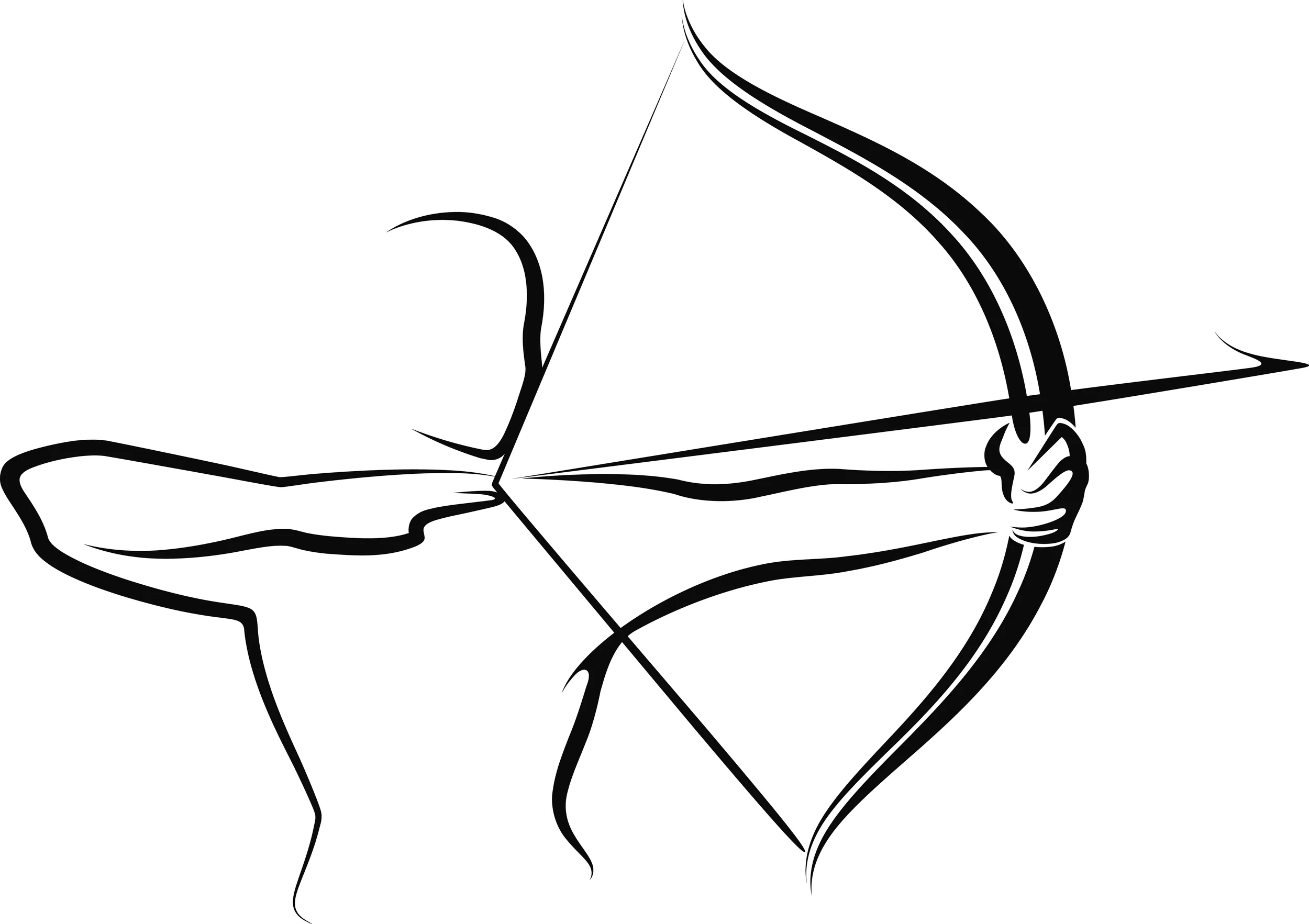
If you shoot an arrow, you must first get your eye very keenly focused on the target. Once you clearly see your target, you pull back on the bow, re-focus your eye in-line with the arrow, and finally release the arrow in the direction of the target. Imagine trying to shoot the arrow without pulling back on the bow. It would fall to the ground next to your feet, right? What if you take your eye off of the target as you release the bow? The arrow will launch in whatever direction you have it pointed, but will most likely land nowhere near the target. If you have a cramp in your shoulder or neck, how much energy is available to pull back the bow in order to launch the arrow with great speed and precision?
To avoid wandering too far into the metaphor weed patch, I will make this point: If you bump into resistance along the way, sometimes you can power through and just “gitter done,” possibly hampering your best energetic output. If you take your eye off the target (your goals, desired outcome, a dream you are making into your reality) you may miss it by a long shot. If you do not take a moment to lean back so you can get crystal clear on your goal, how will you aim, and will you even see the target? What’s more, how will you prepare yourself to build the momentum needed to get you through to the finish?
So, “it depends” is a simple and complex answer to the question: How do we know when it is appropriate to lean back, and how do we know when to push through to the finish?
It depends, really, on your answers to the following 2 questions:
- Do you know what you want and why you want it?
- Are you willing to commit to reaching your goals, even if you need to slow down, lean back, adjust, re-adjust and re-focus regularly?
It seems that I have circled back to willingness. One way to measure your willingness is by taking action. If you can answer question 2 honestly, and you answer “Yes”, then the easiest and most obvious “proof” is in your action. Here is where I may muck-up the simplicity of “it depends” and contradict myself: Sometimes we need to take a step even if we are uncertain if we are heading in the right direction.
Wait.....didn’t I just say to slow down, lean back, focus on the target? Yes. However, if you are prone to “Analysis Paralysis” (and you know who you are, right?!) and you painfully comb-over every detail, ultimately stalling getting started, let alone making any progress, you might need to look at your target, remind yourself of why you want to get there, and just go for it. This is a kind way of telling you to kick your own backside into gear, with love.
Dr. Martin Luther King, Jr. said it best,
“Take the first step in faith. You don’t have to see the whole staircase, just take the first step.”
When we are very clear on what we want and WHY we want it, then stepping out in faith is easy. Ask yourself those two questions regularly, and write down or speak-out your answers. Breathe life into your dreams and desires every day, and take at least one step toward them. You are actively leaning back and focusing by asking those two questions, so if you continue to ask and answer honestly, you will be performing the delightful dance of slowing down to speed up, and you know what? You’ll launch forward like a rocket. You will. Trust me; I’ve been there, I return there, I re-start there and I manifest from there. Know that you are fully supported in your journey, and have faith in yourself and your abilities. Stepping out in faith requires very little beyond understanding why you want what you want.
Blessings. Gratitude. Love.
If you want to get crystal clear on what you want and why you want it, click here to schedule a powerful coaching consultation.
Are you ready to commit to yourself? Do you want to go beyond thinking and talking about making change in your life, and flip to DOING? Schedule your complimentary powerful coaching consultation.
How Do You Show Up? Refine.
“Discipline is the refining fire by which talent becomes reality.” ~ Roy L. Smith
When I was growing up, my parents and teachers seemed to use the word discipline interchangeably with punishment and consequences, and I used to have a visceral reaction to people telling me that if I wanted something, I merely needed to discipline myself enough to practice my craft every day. Now that I am “all grown up” and have some perspective, I agree wholeheartedly (now that I’ve gotten over my teenaged self’s knee-jerkiness). I’m here to share with you that if you understand why you want what you want, then the simplest way to achieve is to first make the decision, commit, make some adjustments and, finally, refine your habits. In my mind, excellent habits means committing to a certain amount of discipline.
Over the past few weeks I’ve written about making the decision, committing and making adjustments to how you choose to show up. We understand that it takes 21-35 days to create a new habit, so I hope that you have been taking some time every day to practice how you show up, and when necessary, revisit why you made the decision you made (to show up strong, confident, peaceful, etc.)
In my coaching practice, my clients learn a lot about habits. You see, the more we practice our new and good habits, whether for lifestyle, career, or relationship success, the faster we reach our goals. Practicing a new habit is a way to replace an old habit that no longer serves you, and to create an effortless draw toward the success you crave. Simply put: make your own life easier every day by making powerful choices to change your life.
In the interest of keeping it simple, I am offering an easy way for you to refine your choices in how you show up.
3 Steps to Refining Habits:
- Choose one new habit. Commit to work and focus on that for 30 days. Of course, there will be other things you will work on, but really focus on and commit to that particular one (eg., taking a deep breath before you speak - every time).
- Write it down every day. Breathe life into it by writing it down, or by speaking it out. This renews your commitment to it, and is a disciplined practice.
- At the end of the day, celebrate your achievements. At the end of each day, review your day, and make sure you celebrate that you have practiced the discipline of breathing life into your new habit. You can simply say, “I did it!” and that is a celebratory acknowledgement of your success. It IS that simple.
Give this a try. Share your journey with me by leaving a comment below. I would love to hear from you and celebrate YOUR success!
Blessings. Gratitude. Love.
Are you ready to refine your choices? Want to go beyond blogs and videos? It would be my pleasure to set aside an hour to share a powerful coaching consultation with you. Click here to schedule your call.
“Refining is inevitable in science when you have made measurements of a phenomenon for a long period of time.” ~ Charles Francis Richter
Do YOU Experience Growing Pains? How Do You Know?
 How do you know when you are experiencing growing pains?
Young children often experience pain in their legs, the cause of which is difficult to pinpoint. Because growing pains is not actually a medical condition, doctors call it a “diagnosis of exclusion”. Excluding other potential maladies or injuries is the first order of business, and by exclusion, many parents find that their child is experiencing the general muscular discomfort referred to as “growing pains”. Consensus in the medical community is that bone growth does not cause pain. However, many children experience more growing pains during the rapid growth stages, into early adolescence. It is understood is that many children experience these pains after a very physically active day, and often for several days and nights in a row. Most doctors agree that the treatment for growing pains is a warm compress, massage and cuddling - a little TLC, if you will (insert winky smile at clever reference to my initials.)
How do you know when you are experiencing growing pains?
Young children often experience pain in their legs, the cause of which is difficult to pinpoint. Because growing pains is not actually a medical condition, doctors call it a “diagnosis of exclusion”. Excluding other potential maladies or injuries is the first order of business, and by exclusion, many parents find that their child is experiencing the general muscular discomfort referred to as “growing pains”. Consensus in the medical community is that bone growth does not cause pain. However, many children experience more growing pains during the rapid growth stages, into early adolescence. It is understood is that many children experience these pains after a very physically active day, and often for several days and nights in a row. Most doctors agree that the treatment for growing pains is a warm compress, massage and cuddling - a little TLC, if you will (insert winky smile at clever reference to my initials.)
If we piggy-back on a child’s experience of growing pains and the doctor’s diagnosis of exclusion, we may apply this to our own experience as adults. Have you ever gone through a difficult time, and yet all other variables seem to be in place? I certainly have. There have been times when I’ve felt stressed, afraid and overwhelmed, and yet so much good stuff was happening in my life. By process of elimination (or exclusion), I often find that during these times, I am experiencing growing pains - a general discomfort associated with a sustained high level of activity.
Think about it. We grow and stretch, and stretch a little more, and leap and stretch, and duck and dodge bullets, and deftly maneuver around roadblocks every day. When you experience an unexplained sense of discomfort, or possibly pain, which could manifest in the forms of sadness, anger, frustration or apathy (however fleetingly temporary), it is helpful to run through your personal checklist of needs, unmet needs and possible adverse health conditions if you have any. If you turn up empty handed, give a nod to the idea of growing pains. Perhaps you have been so active that your whole being needs to rest and recuperate.
The doctor’s diagnosis of growing pains, and the parent’s remedy is simple: rest, warm compress, massage and cuddling - a little TLC. We often barge ahead in life, rapidly barreling forward, without taking a moment to address some of our basic needs. We all need TLC, love, a massage and the equivalent of a warm compress. Reach out to those who are close to you. Ask for some extra support in the form of kind words, a listening ear, a hug or thoughts/prayer. At the same time, be kind and compassionate with yourself. Make sure you have attended to your needs. Pushing through the pain is sometimes recommended, and sometimes rest and recuperation are just what the doctor ordered. Know yourself well enough to distinguish what you really need.
If you want to learn more about establishing the mindset for growing thru your growing pains and achieving blissful success, schedule your COMPLIMENTARY 30 minute consult.
I am here by your side on your journey, cheering you on, applying the warm compress, and offering a lot of TLC. Know that you are fully supported in your dreams, and you WILL manifest them!
Blessings. Gratitude. Love.
SUCCESS: You get to choose
 Today I really wanted to write something flowery about how you deserve an exquisite life, and I believe that. However, for the last several days, I have been home with a sick kid, got the same virus and now am looking out the window at freezing rain. Frankly, as loving and nurturing as I am, I’m just not feeling it today. So, you get a gritty-for-me, sassified chat.
I’ve been seeing a lot of posts on Facebook lately that feel very judgmental and remind us that we’re responsible for our own happiness AND misery, to stop making excuses and that have a strong tone of “you only have yourself to blame,” etc. Here’s the deal: shit happens. Life happens. There are times when it seems things won’t go right, and there are times when life feels heavy. It’s what we choose to do with these times that really matters.
Today I really wanted to write something flowery about how you deserve an exquisite life, and I believe that. However, for the last several days, I have been home with a sick kid, got the same virus and now am looking out the window at freezing rain. Frankly, as loving and nurturing as I am, I’m just not feeling it today. So, you get a gritty-for-me, sassified chat.
I’ve been seeing a lot of posts on Facebook lately that feel very judgmental and remind us that we’re responsible for our own happiness AND misery, to stop making excuses and that have a strong tone of “you only have yourself to blame,” etc. Here’s the deal: shit happens. Life happens. There are times when it seems things won’t go right, and there are times when life feels heavy. It’s what we choose to do with these times that really matters.
So, life happens. Life sometimes feels heavy. There are times when you won’t be able to make it to the gym, you will miss your meditation or you will eat or drink the “wrong” stuff. If you choose to throw the proverbial baby out with the bathwater, then you are choosing that. That is one choice. I will ask you this, and I know I’ve used this analogy before, but it works: if you are wearing a white shirt at a party and a drop of red salsa falls on it, will you pick up the whole bowl of salsa and pour it down your shirt? If you do, bravo/a for making a Powerful Choice! And if not, that is also a Powerful Choice (wink, wink).
You see, whatever you choose, even if you choose to walk in circles and not make a decision, you are making a choice. It is simple. When life throws some crap at the fan and it’s blowing all over, you get to choose: let it hit you, turn and run, grab an umbrella and cover up, or walk around the friggin’ fan and pull the plug. YOU are in command of your life. YOU get to choose how things will go down once they happen, and frankly, THAT is what really counts.
Here are 3 simple steps to deal with Life Happening:
- Breathe. When life happens, stop what you are doing and take a deep breath. Breathe in thru your nose, hold it for a second, and then breathe out thru your nose. Focus on your breath. When you breathe like this (in yoga: ujjayi pranayama) you do a number positive things for yourself, including bringing yourself into the present moment, lowering your blood pressure, slowing down your heart rate, releasing tension and keeping yourself from any knee-jerk reaction that may be associated with old programming that no longer serves you, if it ever did.
- Allow feelings. We often make the mistake of rushing to feel better in the moment of Life Happening. Sometimes we need to switch gears to un-do old programming, but often what we are really doing is stuffing-down our feelings and burying them. To quote a powerful book: feelings buried alive never die. Whatever we stuff down will ultimately back up on us. If we understand that we feel first, then think, then emote, it is easier for us to learn to breathe and rest-in to our feelings and allow whatever we feel to actually be felt. From there, we can heal. Also, remember that feeling feelings and expressing emotions are very different. In the moment you feel something, you get to choose what to do with it.
- Make a choice. After you take a deep breath (or 3, or 10) and have allowed yourself to feel what you feel, you get to make a choice. Choosing is a form of taking action. You may simply choose to change your attitude, and that is action. You may choose to change something - make an apology, forgive yourself or someone else, or rearrange your closet. Whatever you do, make a solid choice, and the universe/god/your source/your higher conscience will conspire to meet you where you are in that choice.
“I discovered I always have choices and sometimes it’s only a choice of attitude.” - Unknown
Whatever you choose, you will do it in a powerful way, and it will be the right thing, even if the outcome is not what you expected or thought you wanted. You see, life happens. Life brings us exactly what we need, when we need it, and we get to choose to experience it as a learning opportunity or as a heavy burden that makes us miserable.
I know you will choose wisely and you will choose whatever you need most, even if you are not fully aware of why you are making the choice.
Blessings. Gratitude. Love.
P.S. It’s still January, and I’m still offering FREE GOODIES. Have you asked me for a freebie? If not, why not? Contact me, and make sure you leave your name & email in the box at the TOP RIGHT of this page so you get your first batch of free stuff. Make sure you ASK ME for more free stuff!
Pain and Suffering: Healing and growing through acceptance

“Out of suffering have emerged the strongest souls; the most massive characters are seared with scars.” - Kahlil Gibran What a powerful statement. We’ve all heard the phrase, “What doesn’t kill you makes you stronger,” right? I suppose that is true, but I do not like the negative connotation, because my literal mind interprets that to mean that great suffering is always negative or that some form of death is imminent. Suffering and pain are a natural part of life. Stuff happens. Life happens, and we cannot control that. We can, however, control how we view life and what we make of our experiences. We can accept the lot we are given and not only make the best of it, but move it the direction we want it to go.
If out of suffering emerge the strongest of souls, then perhaps we need to reach deep down to decide how to use the difficult periods in our lives to build our character and emerge from the ashes stronger, more powerful and ready for action. We all have our own story, and if you know me personally or follow this blog, then you know that I’ve had a significant amount of life change in the past couple of years. Much of that change arose from profoundly painful decisions and experiences, but those were necessary in order for me to find my way to where I am now.
I used my pain as the impetus to start my new life. I will not say I have been able to to this with grace and dignity every step of the way, but I do my best every day given the circumstances and the resources I have (energy, emotional intelligence, time, strength.) I believe scars show as reminders of what we have learned, and will fade over time. I also believe, however, that the challenge is to keep the scars from hindering our ability to continue to move, as some scar tissue does after injury or surgery. This is a strong metaphor. If we leave our painful experiences in place and do nothing to massage, stretch or heal the damaged ares, we will eventually lose some of our mobility.
When the physical body sustains an injury or is recovering from surgery, there are three distinct stages of healing: Acute Inflammation, Repair and Remodeling. I compare the emotional and spiritual healing process to the physical, because I believe that the mind, body and spirit are interconnected, and frankly, linking our emotional healing to something tangible like tissue repair can give us hope and focus. The end of a relationship is an excellent example of the need for healing and recovery.
Almost everyone has experienced the loss of a relationship, either by their own choice or by the other person’s choice. It hurts, is often a blow to the ego and emotions, and can take some time to recover.
Stage 1. Acute Inflammation. This is the time immediately following injury. When a relationship ends, there is a period of pain, sometimes experienced as anger, hurt, frustration, sadness or some combination thereof. As with physical injury, this is very normal. The immediate response is pain, swelling, heat and redness. Inflammation is an imperative part of healing because it helps defuse the toxins to allow the healing process to begin. Plainly stated, we have to feel the injury, the pain, swelling of emotions, and discomfort in order to rid our system of the toxins and negativity that would otherwise fester into something far worse and potentially more damaging. As inflammation decreases, the repair process can begin.
Stage 2. Repair. Damaged structures begin the repair process by forming new connective tissues. This is a fragile time when the injury should not be touched. Only gentle stretching, beginning slowly, and gradually building in intensity over time. At this point, the healing process is building toward remodeling, the final stage.
There is always a period of time after a relationship ends when we need to get ourselves right before we “move on” to another relationship. There is no definite timeframe for this, but we all know we need to take the time to heal, work on figuring ourselves out, learning what we need to learn. This is the time when we are most fragile, and as with physical healing, it is recommended that you allow yourself to heal before hitting the ground running again.
Stage 3. Remodeling. This is the time when you need to take a more active role in your healing. Damaged tissues can be “remodeled” thru a series of range of movement exercises. How fantastically symbolic! Once you have experienced the pain of the injury, given yourself time to feel the pain, allowed the inflammation to push the toxins out of your system, gently eased back into life - into a more active role in your recovery - then you can really remodel and reshape your life.
Taking into account the natural healing process, we can treat difficult times as we would an injury or recovery from surgery by taking this attitude: “Here I am, what now?" or, "It is what it is, now what?” We accept that something has happened, and now we need to recover from it. How do we best do this? It seems for the most part that we readily accept a physical injury and the need to heal from it, but emotionally and spiritually, this presents as a larger challenge. If we change one thing, our perspective, and just accept that we need to heal and move forward, we will already begin to grow in the right direction.
“In the difficult are the friendly forces, the hands that work on us.” - Rainer Maria Rilke
We have the real opportunity to live fully, with deep meaning and fulfillment. We can all get there with acceptance, love and faith. Allow the hard times to help shape the amazing path in front of you. Let yourself feel the pain, let it flow, and then take an active part in your recovery and keep moving forward. As you travel in this amazing journey called life, you will encounter bumps, twists and turns; this is your time to make that jagged path into something beautiful.

Mind, Body & Spirit
“We are not human beings having a spiritual experience. We are spiritual beings having a human experience.” ~ Teilhard de Chardin
In Western culture, we are now beginning to understand the importance of the physical, emotional and spiritual connectedness of overall personal wellness. I believe that in order to be well in one area - for example, physically - all other areas must also be well. How does one achieve this overall wellness?
Let’s break it down by category to give a brief overview of each, and then tie the three parts together to complete the picture.
Physical Wellness - Physical body, appearance, health, mental state: Food, quantity and quality of sleep, exercise, hydration, physical health, stress management, dis-ease prevention and management.
Emotional Wellness - Thoughts, self-love and appreciation, emotional intelligence: Self-reflection, self-perception, perception of others, communication, managing expectations and capacity to love unconditionally, forgive and experience gratitude.
Spiritual Wellness - Religion, faith, belief system: Meditation, prayer, journal writing, positive affirmations, positive thoughts, slowing down, deep breathing and time to oneself.
There are many schools of thought on the origins of dis-ease, but most can be traced to some form of physical tension or stress in the body, which is often caused or exacerbated by emotional distress or discomfort. Whether one believes that specific emotional distress causes specific physical ailments, we all understand that the effects of prolonged stress on the physical body and emotional state can be detrimental to health and wellbeing.
According to the Mayo Clinic, stress can significantly affect your body, mood and behavior. Stress can also contribute to headaches, muscle tension, high blood pressure, heart problems, diabetes, skin conditions, asthma, arthritis, depression, decreased libido, stomach upset, sleep disruptions, irritability, lack of motivation and focus, over- or under-eating, drug or alcohol abuse and anxiety.
Ensuring adequate nutrition, hydration, exercise and sleep is one way to relieve the stress of daily life. While tending to our physical needs, it is also very important to build our tribe of support around us to help us with our emotional needs. Developing a spiritual practice of regular prayer or meditation, deep breathing exercises and yoga or gentle stretching and energy work such as Reike, build the foundation for healing, restoration, and nourishing the body, mind and spirit.**
**As a coach and as a living human being, my approach to all areas of life is holistic in nature. I will only share insights that I believe to be helpful, reminding you to check-in with yourself, your physician or mental health care provider. Sometimes it takes a team of experts to bring us back into balance physically, emotionally and spiritually. When you have the right team in place, you are more likely to reach the level of success you desire. If you have not found answers to your questions, I highly encourage you to keep asking until you find an answer that provides a viable solution that not only meets you where you are, but takes you where you want to be in terms of your physical, emotional and spiritual wellbeing.
