

The Hidden Financial Challenges of Physician Ownership Featuring Anjali Jariwala, EP 219
Financial planning expert Anjali Jariwala joins Tracy to discuss the unique financial challenges physician practice owners face and why comprehensive planning requires both personal wealth management and business strategy. With her background in tax and financial planning plus personal ties to the physician community, Anjali offers insider perspective on navigating the complex transition from residency to high earnings, building sustainable businesses, and creating alignment between personal values and professional goals.
Financial planning expert Anjali Jariwala joins Tracy to discuss the unique financial challenges physician practice owners face and why comprehensive planning requires both personal wealth management and business strategy. With her background in tax and financial planning plus personal ties to the physician community, Anjali offers insider perspective on navigating the complex transition from residency to high earnings, building sustainable businesses, and creating alignment between personal values and professional goals.
Is your practice growth-ready? See Where Your Practice Stands: Take our Practice Growth Readiness Assessment
Episode Highlights
The physician financial transition challenge: Why going from minimal resident income to high earnings overnight creates both financial and emotional complications that most physicians aren't trained to handle
Personal before business: Anjali's approach of spending 2-3 months on personal financial planning before touching business finances, and why this sequence creates better long-term alignment
Accountant vs. strategist: The critical distinction between historical accounting and forward-looking financial strategy—and why practice owners need both
Growth barriers decoded: How to recognize when your practice has hit a growth ceiling and what changes are typically needed to break through
The guilt factor: Why physician owners struggle with asking for help or outsourcing tasks, and how to reframe these decisions as strategic investments
Building your professional team: Beyond your clinical team, you need accountants, tax specialists, financial advisors, and attorneys—here's how to leverage them effectively
Know your numbers: Why practice owners must understand their books better than anyone else, even when outsourcing bookkeeping functions
Time as currency: Calculating your hourly rate and using it to make smarter decisions about which tasks to keep versus delegate
Memorable Quotes
"At the end of the day, money is a tool. We have emotions that get tied up in it, but we really need to unwind the emotion from the fact that this is just a tool."
"For many practice owners, your personal finances are so interconnected with the business that I want to have clarity on what you want to achieve personally. So then when I go into the business, we can align everything up to meet those goals."
"Part of it is identifying what are your strengths and where are your weaknesses, and then who are the people that you can plug in to help you with those weaknesses so it's not hindering your ability to grow."
"We spend so much time working in the business because we want to provide good care and take care of our clients and patients, that we don't focus enough time on working on the business."
"There's sometimes feelings of guilt to ask for help. Part of it is really coming at it from a standpoint of: I need help, it's okay to ask for help, and I shouldn't feel guilty about asking for this help because it's going to make my life better, my family's life better, and all the people who work for me better too."
Closing
Anjali's message about releasing the guilt around asking for help really resonates. As practice owners, we often carry this sense that we should be able to handle everything ourselves—but that mindset actually limits our growth and our impact. Whether it's financial planning, operations support, or strategic guidance, building the right team of trusted advisors isn't a weakness—it's how you create a practice that truly thrives.
Bio:
Anjali Jariwala is the founder of FIT Advisors, a financial planning firm serving physicians and business owners across the US. After working with Fortune 500 clients at distinguished firms, Anjali launched her own practice to help clients understand that money is a tool for reaching financial goals—while acknowledging how emotions impact financial decisions. Her expertise in tax and finance has been featured in CNBC, Bloomberg, The New York Times, USA Today, and Business Insider. Beyond financial planning, Anjali is also a children's book author. As a South Asian mom, she wrote Why We Eat With Our Hands to highlight day-to-day cultural traditions and increase representation for children who look like her daughter. Whether through financial advising or children's literature, Anjali is passionate about helping people feel empowered to build the lives they want.
Find Anjali:
See Where Your Practice Stands: Take our Practice Growth Readiness Assessment
Connect With Us:

Behind the Research: What 18,000 Physicians Can't Tell Us About Private Practice Burnout - A Special Snack Episode, EP 218
In this candid snack episode, Miranda interviews Tracy about the research behind their white paper, "Unlocking Potential: A Business Blueprint for Practice Owners." Tracy reveals a startling discovery: the largest burnout studies—including the AMA's 18,000-respondent survey—systematically exclude private practice owners, focusing exclusively on employed physicians in large systems. This two-year-old research remains urgently relevant as healthcare continues evolving post-COVID. Tracy shares surprising insights from provider interviews, explains why the distinction between working in versus on your practice matters, and offers realistic expectations for reclaiming your time through strategic business planning.
In this candid snack episode, Miranda interviews Tracy about the research behind their white paper, "Unlocking Potential: A Business Blueprint for Practice Owners." Tracy reveals a startling discovery: the largest burnout studies—including the AMA's 18,000-respondent survey—systematically exclude private practice owners, focusing exclusively on employed physicians in large systems. This two-year-old research remains urgently relevant as healthcare continues evolving post-COVID. Tracy shares surprising insights from provider interviews, explains why the distinction between working in versus on your practice matters, and offers realistic expectations for reclaiming your time through strategic business planning.
Download the White Paper: “Unlocking Potential: A Business Blueprint for Practice Owners”
Episode Highlights
The Missing Data: Why major burnout studies exclude independent practice owners and what this means for healthcare policy
Lower Burnout Rates: Evidence that practice owners experience slightly lower burnout rates due to greater autonomy—but remain at significant risk
COVID's Impact: How the pandemic intensified an already urgent workplace crisis that the WHO identified as early as 2019
Refreshing Candor: The surprisingly honest conversations practice owners had about their biggest frustrations (insurance companies top the list)
Working In vs. On: The critical difference between clinical tasks and strategic leadership—and why the 10,000-foot view matters
The Long Game: Why meaningful time recapture takes 3-6 months of consistent effort and why it's worth the investment
Healthcare Is Different: Why business principles apply to medical practices with crucial distinctions that generic business advice misses
Memorable Quotes
"I don't believe to this day, even two years on, that the data is actually very clear about practice owners."
"The burnout rates are lower because practice owners have more autonomy, comma, and they're still at risk at pretty much the same rates."
"Practice owners are the redheaded stepchild of burnout research."
"What surprised me was how candid they were as soon as we could get them to talk."
"Business is business, comma, and it's just different in healthcare. And we get that because we work in it with you."
"Everything you're doing now, if it's going to be an adjustment, it's going to take time to come back, but it's so worth the investment of time and energy."
Closing
This conversation underscores why advocacy for independent practice ownership remains central to our mission. When research systematically overlooks a segment of healthcare providers, policies get shaped without their reality in view—and that's exactly when practice owners need the most support. Download the white paper to validate your experience and discover practical strategies for sustainable growth.
Download the White Paper: “Unlocking Potential: A Business Blueprint for Practice Owners”
Is your practice growth-ready? See Where Your Practice Stands: Take our Practice Growth Readiness Assessment
Miranda’s Bio:
Miranda Dorta, B.F.A. (she/her/hers) is the Manager of Operations and PR at Tracy Cherpeski International. A graduate of Savannah College of Art and Design with expertise in writing and creative storytelling, Miranda brings her skills in operations, public relations, and communication strategies to the Thriving Practice community. Based in the City of Oaks, she joined the team in 2021 and has been instrumental in streamlining operations while managing the company's public presence since 2022.
Tracy’s Bio:
Tracy Cherpeski, MBA, MA, CPSC (she/her/hers) is the Founder of Tracy Cherpeski International and Thriving Practice Community. As a Business Consultant and Executive Coach, Tracy helps healthcare practice owners scale their businesses without sacrificing wellbeing. Through strategic planning, leadership development, and mindset mastery, she empowers clients to reclaim their time and reach their potential. Based in Chapel Hill, NC, Tracy serves clients worldwide and is the Executive Producer and Host of the Thriving Practice podcast. Her guiding philosophy: Survival is not enough; life is meant to be celebrated.
Connect With Us:
Be a Guest on the Show
Thriving Practice Community
Schedule Strategy Session with Tracy
Tracy’s LinkedIn
Business LinkedIn Page

The Time Trap: Why Independent Practices Are Disappearing (And the Swell Coming to Save Them), EP 217
Independent healthcare practices are at a critical crossroads. Based on original research from Tracy Cherpeski International's white paper "Unlocking Potential: A Business Blueprint for Practice Owners," this episode reveals the time crisis threatening independent practice ownership—and the surprising wave of change on the horizon. Tracy shares data showing that practice owners spend up to 35% of their time on administrative tasks, while 80% dream of a future with more strategic freedom. But there's hope: with proven time leadership strategies, practice owners are reclaiming 5-10 hours weekly and building sustainable practices that support both exceptional patient care and quality of life.
Independent healthcare practices are at a critical crossroads. Based on original research from Tracy Cherpeski International's white paper "Unlocking Potential: A Business Blueprint for Practice Owners," this episode reveals the time crisis threatening independent practice ownership—and the surprising wave of change on the horizon. Tracy shares data showing that practice owners spend up to 35% of their time on administrative tasks, while 80% dream of a future with more strategic freedom. But there's hope: with proven time leadership strategies, practice owners are reclaiming 5-10 hours weekly and building sustainable practices that support both exceptional patient care and quality of life.
Is your practice growth-ready? See Where Your Practice Stands: Take our Practice Growth Readiness Assessment
Episode Highlights
The shocking data on how much time practice owners lose to administrative work weekly
Why physician practice ownership dropped 13 percentage points from 2012-2022
The emerging wave of young and mid-career physicians choosing independent practice ownership
Dr. Noah's story: From drowning in admin work to reclaiming his practice and his life
The "garden sunlight" framework for understanding strategic time allocation
What's at stake if we don't support the next generation of practice owners
Proven strategies that help owners reclaim 5-10 hours per week
Memorable Quotes
"The biggest threat to independent healthcare practices isn't private equity buyouts or declining reimbursements—it's how practice owners are spending their time every single week."
"Medical school teaches you how to diagnose and treat patients. It doesn't teach you how to build systems, delegate effectively, or think like a CEO."
"Your time as a practice owner is like sunlight in a garden. If you spread it too thin across every single plant, nothing grows particularly strong."
"We're at an inflection point. And the question is: will these courageous physician entrepreneurs have the support, resources, and business knowledge they need to succeed?"
"Independent healthcare practice ownership doesn't have to be a path to burnout. With the right approach, it can be exactly what you envisioned."
Resources
Download the full white paper: "Unlocking Potential: A Business Blueprint for Practice Owners"
Register for the November 18th Time Leadership Masterclass (Open to everyone!)
Learn more about Thriving Practice Community membership.
Tracy’s Bio:
Tracy Cherpeski, MBA, MA, CPSC (she/her/hers) is the Founder of Tracy Cherpeski International and Thriving Practice Community. As a Business Consultant and Executive Coach, Tracy helps healthcare practice owners scale their businesses without sacrificing wellbeing. Through strategic planning, leadership development, and mindset mastery, she empowers clients to reclaim their time and reach their potential. Based in Chapel Hill, NC, Tracy serves clients worldwide and is the Executive Producer and Host of the Thriving Practice podcast. Her guiding philosophy: Survival is not enough; life is meant to be celebrated.
Connect With Us:

Teaching Burnout Prevention While Burning Out: What Actually Saves Us, EP 216
In this raw and honest solo episode, Tracy Cherpeski shares what happened when the burnout prevention expert found herself sliding into Stage 4 burnout. During one of the busiest seasons of her career - launching Thriving Practice Community, facilitating a CME-accredited wellness retreat, and developing new programs - Tracy experienced firsthand the insidious nature of burnout she teaches others to prevent. But this isn't just a story about struggle. It's about what actually works: the difference between near-burnout and full burnout, why clarity is 50% of prevention, and why community isn't optional but essential infrastructure for sustainable practice. Through stories from a powerful San Jose gathering and TPC's inaugural Community of Practice session, Tracy reveals what healthcare leaders are truly hungry for and what most of us are trying to survive without.
In this raw and honest solo episode, Tracy Cherpeski shares what happened when the burnout prevention expert found herself sliding into Stage 4 burnout. During one of the busiest seasons of her career - launching Thriving Practice Community, facilitating a CME-accredited wellness retreat, and developing new programs - Tracy experienced firsthand the insidious nature of burnout she teaches others to prevent. But this isn't just a story about struggle. It's about what actually works: the difference between near-burnout and full burnout, why clarity is 50% of prevention, and why community isn't optional but essential infrastructure for sustainable practice. Through stories from a powerful San Jose gathering and TPC's inaugural Community of Practice session, Tracy reveals what healthcare leaders are truly hungry for and what most of us are trying to survive without.
Is your practice growth-ready? See Where Your Practice Stands: Take our Practice Growth Readiness Assessment
Episode Highlights
The irony of teaching burnout prevention while experiencing Stage 4 burnout during an intense launch season
What happened at the San Jose CME-accredited wellness event when physicians finally had space to connect
The "worst wellness advice ever" improv game that revealed the band-aid solutions healthcare leaders are tired of hearing
Dr. Robert's story: navigating impossible income swings, two practice models, and life-altering decisions completely alone
Gianna's journey: why even successful practice owners need community to navigate next-level growth decisions
The WHO's 12 stages of burnout and why Stages 1-4 look exactly like the "model physician"
Why clarity about your WHY is at least 50% of burnout prevention
How community serves as prevention infrastructure, not just a cure for burnout
The difference between three days of intentional rest and three months of burnout recovery
Memorable Quotes
"The irony was not lost on me. And that's the thing about burnout - it's insidious. You don't see it creeping up until suddenly, you're in it."
"That feeling of 'I'm keeping all these plates spinning but I've lost sight of why I'm in the circus to begin with.'"
"My body basically said, 'Okay, you pushed through the event, now you're STOPPING whether you like it or not.'"
"The 'worst advice' they were sarcastically giving? That WAS their lived experience."
"They grabbed onto connection like oxygen."
"And that's what I mean by isolation at the survival level. It's not that he's not capable - he's proven he is. It's that he's trying to navigate impossible complexity without anyone who actually understands the terrain."
"Success doesn't eliminate the need for community. It just changes what you need community FOR."
"Clarity is at least 50% of burnout prevention."
"Community isn't optional. It's infrastructure."
"Isolation intensifies everything. The doubt. The comparison. The overwhelm. The weight of decisions."
"That's the power of community. Not as a cure for burnout, but as prevention. As the structure that keeps you from getting there in the first place."
"This isn't about waiting until you 'have it all figured out' to connect with peers. It's about recognizing that connection IS how you figure it out."
Closing
Tracy's vulnerability in this episode is a gift. She didn't just teach us about burnout prevention - she showed us what it looks like to catch yourself at Stage 4, course-correct with clarity and community, and come out stronger. If you're feeling isolated in your practice, making high-stakes decisions alone, or wondering if you have time for community, this episode is your reminder: you don't have time NOT to invest in connection and clarity. Because without them, you'll keep spinning until your body forces you to stop.
Tracy’s Bio:
Tracy Cherpeski, MBA, MA, CPSC (she/her/hers) is the Founder of Tracy Cherpeski International and Thriving Practice Community. As a Business Consultant and Executive Coach, Tracy helps healthcare practice owners scale their businesses without sacrificing wellbeing. Through strategic planning, leadership development, and mindset mastery, she empowers clients to reclaim their time and reach their potential. Based in Chapel Hill, NC, Tracy serves clients worldwide and is the Executive Producer and Host of the Thriving Practice podcast. Her guiding philosophy: Survival is not enough; life is meant to be celebrated.
Connect With Us:

Buy-Ins, Buyouts, and Why Your Practice Needs a Plan B, Featuring Debra Phairas, EP 215
In this episode, Tracy sits down with Debra Phairas, a physician practice management consultant with over 40 years of experience working with more than 2,300 medical practices. They discuss the often-overlooked topics of buy-ins, buyouts, and exit strategies for private practices. Debra shares hard-earned wisdom from four decades in the field, including real stories that illustrate why planning ahead isn't optional—it's essential.
In this episode, Tracy sits down with Debra Phairas, a physician practice management consultant with over 40 years of experience working with more than 2,300 medical practices. They discuss the often-overlooked topics of buy-ins, buyouts, and exit strategies for private practices. Debra shares hard-earned wisdom from four decades in the field, including real stories that illustrate why planning ahead isn't optional—it's essential.
See Where Your Practice Stands: Take our Practice Growth Readiness Assessment
Episode Highlights
The Buy-In Advantage: Why buying into an established practice can be smarter than starting from scratch, and what to look for in a shareholder agreement
Show You're Partner-Worthy: How young doctors can demonstrate value through marketing activities and relationship-building with referring physicians
The Uncomfortable Necessities: Why every practice owner needs a will, living trust, buy-sell agreement, and key person insurance—illustrated with real stories of practices that didn't plan ahead
Transparency is Everything: How open communication between senior and junior partners prevents dissatisfaction and builds lasting trust
The Exit Strategy: Planning 2-5 years ahead for retirement or sale, and why waiting until you're 80 is too late
The Private Practice Renaissance: Why more young doctors are choosing private practice ownership post-COVID
Memorable Quotes
"Transparency is really the key to good working relationships. The more that you know about the practice when you're coming in, the better decisions you can make."
"You put a dollar sign in front of math and you all freak out. You did way harder math to get into medical school. This is really easy—it's just simple math."
"The courage to communicate, confront, and compromise are my watchwords that I give all my doctors."
"At least when you buy in, you will have something when you leave. If you're just an employee, you get nothing."
"I've been so encouraged this year. I have done more new startup practice meetings than I did for the last three years. So many young doctors are saying they're ready to start their own practice—and that's something to celebrate."
Debra Phairas reminds us that running a private practice doesn't have to be as daunting as it seems. With proper planning, transparent communication, and the right guidance, physicians can build sustainable practices that provide both professional satisfaction and financial security. Whether you're just starting out or planning your exit, the key is to start those conversations now—not when it's too late.
Guest Bio:
Debra Phairas is President of Practice & Liability Consultants, LLC, a nationally recognized firm specializing in practice management and malpractice prevention. With over 40 years of experience, she has consulted with more than 2,300 medical practices across all specialties. Her expertise includes practice startups, financial analysis, practice valuations, buy-ins and buyouts, strategic planning, and partnership agreements. Debra holds a BS from Michigan State University and completed graduate work in Health Services Administration at Golden Gate University. She is a sought-after speaker who has presented seminars nationwide for medical associations and specialty societies, and is certified as an Expert Witness in California, Arizona, and Washington.
Find Debra:
See Where Your Practice Stands: Take our Practice Growth Readiness Assessment
Connect With Us:

The Practice Owner's Guide to Quarterly Planning (and Staying Ahead of the Chaos) - A Special Snack Episode, EP 214
Each quarter brings predictable patterns in patient behavior and practice operations, yet many healthcare providers find themselves constantly reacting instead of planning. In this snack episode, Tracy Cherpeski shares her insights on how practice owners can leverage quarterly shifts to build sustainable growth and avoid burnout. From Q1's deductible reset surge to Q4's strategic planning opportunities, Tracy offers a roadmap for thriving year-round.
Each quarter brings predictable patterns in patient behavior and practice operations, yet many healthcare providers find themselves constantly reacting instead of planning. In this snack episode, Tracy Cherpeski shares her insights on how practice owners can leverage quarterly shifts to build sustainable growth and avoid burnout. From Q1's deductible reset surge to Q4's strategic planning opportunities, Tracy offers a roadmap for thriving year-round.
Episode Highlights:
How to prepare for Q1's patient surge and deductible reset without overwhelming your team
Why Q2 is the perfect time for mid-year assessments and what metrics actually matter
Using Q3's momentum (or downtime) strategically instead of just coasting through summer
The competitive advantage of Q4 planning over end-of-year scrambling
Understanding the "hustle and glide" mentality for sustainable practice growth
The Time Leadership Quadrant: A practical framework for triaging what needs your attention now
Memorable Quotes:
"What you track, you can manage."
"You don't want to make your adjustments in the busy time. It's the analogy of getting caught with your pants around your ankles—it's not a good time to try to run if you are bound."
"If you take some time in Q3 to plan, you'll be at least a quarter ahead of your competition."
"Embrace the hustle and glide mentality—we hustle when it's truly hustle time, and when it's not, you slow down, become more reflective, and recharge your batteries."
"The practice owners who thrive year-round know when to work on the business instead of always being in it."
If you're ready to stop riding the quarterly roller coaster and start planning for predictable success, visit thrivingpracticecommunity.com to schedule a consultation with Tracy today.
Is your practice growth-ready? See Where Your Practice Stands: Take our Practice Growth Readiness Assessment
Miranda’s Bio:
Miranda Dorta, B.F.A. (she/her/hers) is the Manager of Operations and PR at Tracy Cherpeski International. A graduate of Savannah College of Art and Design with expertise in writing and creative storytelling, Miranda brings her skills in operations, public relations, and communication strategies to the Thriving Practice community. Based in the City of Oaks, she joined the team in 2021 and has been instrumental in streamlining operations while managing the company's public presence since 2022.
Tracy’s Bio:
Tracy Cherpeski, MBA, MA, CPSC (she/her/hers) is the Founder of Tracy Cherpeski International and Thriving Practice Community. As a Business Consultant and Executive Coach, Tracy helps healthcare practice owners scale their businesses without sacrificing wellbeing. Through strategic planning, leadership development, and mindset mastery, she empowers clients to reclaim their time and reach their potential. Based in Chapel Hill, NC, Tracy serves clients worldwide and is the Executive Producer and Host of the Thriving Practice podcast. Her guiding philosophy: Survival is not enough; life is meant to be celebrated.
Connect With Us:

Why "Work Smarter Not Harder" Is Terrible Advice (And What Actually Works), Pt. 3, EP 213
In this powerful conclusion to our three-part time leadership series, Tracy tackles one of the most repeated—and least helpful—pieces of productivity advice: "work smarter, not harder." Through the compelling story of Dr. David, an ER physician turned regenerative medicine practice owner, you'll discover why this platitude fails and what to do instead. Tracy introduces a concrete methodology for strategic work allocation that helped Dr. David redirect 15 hours per week from low-value interruptions to high-value work that only he could perform. The result? Substantial revenue growth, improved patient flow, and a more confident, self-sufficient team—all while working the same number of hours.
In this powerful conclusion to our three-part time leadership series, Tracy tackles one of the most repeated—and least helpful—pieces of productivity advice: "work smarter, not harder." Through the compelling story of Dr. David, an ER physician turned regenerative medicine practice owner, you'll discover why this platitude fails and what to do instead. Tracy introduces a concrete methodology for strategic work allocation that helped Dr. David redirect 15 hours per week from low-value interruptions to high-value work that only he could perform. The result? Substantial revenue growth, improved patient flow, and a more confident, self-sufficient team—all while working the same number of hours.
Is your practice growth-ready? See Where Your Practice Stands: Take our Practice Growth Readiness Assessment
Download the Time Leadership Delegation Tool
Episode Highlights
Why "work smarter" is useless advice: It offers zero actionable guidance on how to actually work differently
The critical distinction: Time leadership isn't about getting extra free time—it's about strategic reallocation to work that only you can do
Dr. David's breakthrough: Discovering he spent 15 hours weekly on work that didn't require his expertise
The three strategic changes: Training staff for self-sufficiency, redesigning clinical schedules around highest-value work, and fixing the scheduling system
The scheduling protocol that changed everything: How offering two specific appointment options eliminated chaos and six weekly interruptions
Real results: How 12 redirected hours created substantial revenue increases and improved practice flow
The Discovery-Analysis-Action framework: Tracy's proven methodology for lasting change
Memorable Quotes
"Time leadership isn't about efficiency—it's about effectiveness. It's not about doing things faster—it's about doing the right things and ensuring the wrong things aren't on your plate at all."
"The question isn't 'how do I work smarter?' The question is 'what work should I actually be doing, and what needs to stop being on my plate?'"
"You're not getting 'extra' time. You're reclaiming strategic capacity that's currently being drained by the wrong work."
"Awareness without action is just expensive entertainment. You can understand time leadership intellectually and still be overwhelmed six months from now."
"I finally understand the difference between being busy and being effective. I'm working the same number of hours, but the work I'm doing is completely different." —Dr. David
This episode delivers the practical implementation guide you've been waiting for in the time leadership series. Whether you're a physician, dentist, or other healthcare practice owner, Tracy's methodology for strategic work allocation will help you stop playing every instrument in the orchestra and start conducting. Visit the show notes for your complimentary practice assessment strategy session and take the next step toward building the practice you envisioned.
Is your practice growth-ready? See Where Your Practice Stands: Take our Practice Growth Readiness Assessment
Download the Time Leadership Delegation Tool
Tracy’s Bio:
Tracy Cherpeski, MBA, MA, CPSC (she/her/hers) is the Founder of Tracy Cherpeski International and Thriving Practice Community. As a Business Consultant and Executive Coach, Tracy helps healthcare practice owners scale their businesses without sacrificing wellbeing. Through strategic planning, leadership development, and mindset mastery, she empowers clients to reclaim their time and reach their potential. Based in Chapel Hill, NC, Tracy serves clients worldwide and is the Executive Producer and Host of the Thriving Practice podcast. Her guiding philosophy: Survival is not enough; life is meant to be celebrated.
Connect With Us:

Stop Responding to Fake Urgencies: How to Actually Protect Your Strategic Time, Pt. 2, EP 212
In this episode of Thriving Practice, Tracy Cherpeski tackles one of the biggest challenges healthcare practice owners face: protecting strategic thinking time in an environment where everything feels urgent. Through the compelling story of Dr. David—an ER physician who opened a regenerative medicine practice—you'll discover why your blocked strategic planning time keeps getting hijacked, and learn the exact framework for distinguishing between genuine urgency and habitual urgency. This is part two of the time leadership series, and it's essential listening for any practice owner who's ever wondered why their "do not disturb" time never actually happens.
Overview: In this episode of Thriving Practice, Tracy Cherpeski tackles one of the biggest challenges healthcare practice owners face: protecting strategic thinking time in an environment where everything feels urgent. Through the compelling story of Dr. David—an ER physician who opened a regenerative medicine practice—you'll discover why your blocked strategic planning time keeps getting hijacked, and learn the exact framework for distinguishing between genuine urgency and habitual urgency. This is part two of the time leadership series, and it's essential listening for any practice owner who's ever wondered why their "do not disturb" time never actually happens.
Download the Time Leadership Workbook
Episode Highlights:
Why healthcare practice owners are uniquely vulnerable to losing strategic thinking time
The difference between urgency in clinical care versus practice operations
Dr. David's breakthrough: discovering 15 hours per week of delegable tasks through time tracking
The three questions that help you triage your time like an ER triages patients
The ABCD prioritization framework for categorizing tasks and interruptions
How to create decision-making frameworks that eliminate recurring interruptions
Why tracking your time for just three days can reveal patterns you can't unsee
Memorable Quotes:
"Your strategic thinking time doesn't disappear because healthcare is unpredictable. It disappears because you haven't distinguished between what's genuinely urgent and what just feels urgent."
"In clinical settings, urgency often correlates with importance. But here's the trap: you've imported that same urgency response pattern into every aspect of your practice. And in the business side of healthcare, urgency rarely equals importance."
"You cannot fix what you cannot see."
"The question isn't 'is this urgent?' The question is 'is this urgent and only I can handle it right now?' That's a very different standard."
Ready to reclaim your strategic thinking time? This episode gives you the audit framework and prioritization system to start making immediate changes. Download the Time Leadership Delegation workbook and complete your three-day time audit—then join us for part three, where Tracy shows you how to turn that data into freed-up time.
Is your practice growth-ready? See Where Your Practice Stands: Take our Practice Growth Readiness Assessment
Tracy’s Bio:
Tracy Cherpeski, MBA, MA, CPSC (she/her/hers) is the Founder of Tracy Cherpeski International and Thriving Practice Community. As a Business Consultant and Executive Coach, Tracy helps healthcare practice owners scale their businesses without sacrificing wellbeing. Through strategic planning, leadership development, and mindset mastery, she empowers clients to reclaim their time and reach their potential. Based in Chapel Hill, NC, Tracy serves clients worldwide and is the Executive Producer and Host of the Thriving Practice podcast. Her guiding philosophy: Survival is not enough; life is meant to be celebrated.
Connect With Us:
Schedule Strategy Session with Tracy
The Isolation Trap: How Independent Providers Can Build Their Professional Village – A Special Snack Episode, EP 211
In this candid snack episode, Miranda and Tracy explore the critical importance of building intentional professional community as a practice owner. Drawing from Tracy's recently updated blog post "Choosing Your Village" (originally written in 2011), they discuss why independent healthcare providers need more than clinical expertise—they need a village of people who understand the unique challenges of practice ownership.
In this candid snack episode, Miranda and Tracy explore the critical importance of building intentional professional community as a practice owner. Drawing from Tracy's recently updated blog post "Choosing Your Village" (originally written in 2011), they discuss why independent healthcare providers need more than clinical expertise—they need a village of people who understand the unique challenges of practice ownership.
Episode Highlights
Why community matters more now: The impact of digital connection versus genuine human connection, and how COVID increased isolation for independent practice owners
Village vs. support network: Understanding the difference between personal support and professional community
Energy audit for relationships: How to identify which connections drain you and which ones light you up—and what to do about it
Recovery from burnout: Practical steps for practice owners running on empty, including the WHO's 12 stages of burnout
Incremental progress over perfection: Why starting small (like drinking enough water) creates sustainable change
Memorable Quotes
"I think we are more digitally connected and yet feeling more disconnected. For all humans, we're really feeling that, and COVID really increased our sense of isolation."
"I need professional friends. I need professional colleagues in my world, other business owners... other crazy people who can show you that what you're going through is common, maybe even normal."
"If I'm feeling this way with lots of people, it might be time for me to take a nap and have a snack."
"Mindful means slowing down. Sometimes literally putting my hand on my heart and just checking in."
"It's better, it's more sustainable to start with something that you know you can do. I know I can carry my water bottle around and sip on it all day."
Closing
This episode serves as a gentle reminder that practice ownership doesn't have to be a solitary journey. Whether you're evaluating your current professional relationships or looking to build new connections, the Thriving Practice community is here to support you. Visit thrivingpracticecommunity.com to learn more about working with Tracy and joining a village that truly gets it.
Is your practice growth-ready? See Where Your Practice Stands: Take our Practice Growth Readiness Assessment
Miranda’s Bio:
Miranda Dorta, B.F.A. (she/her/hers) is the Manager of Operations and PR at Tracy Cherpeski International. A graduate of Savannah College of Art and Design with expertise in writing and creative storytelling, Miranda brings her skills in operations, public relations, and communication strategies to the Thriving Practice community. Based in the City of Oaks, she joined the team in 2021 and has been instrumental in streamlining operations while managing the company's public presence since 2022.
Tracy’s Bio:
Tracy Cherpeski, MBA, MA, CPSC (she/her/hers) is the Founder of Tracy Cherpeski International and Thriving Practice Community. As a Business Consultant and Executive Coach, Tracy helps healthcare practice owners scale their businesses without sacrificing wellbeing. Through strategic planning, leadership development, and mindset mastery, she empowers clients to reclaim their time and reach their potential. Based in Chapel Hill, NC, Tracy serves clients worldwide and is the Executive Producer and Host of the Thriving Practice podcast. Her guiding philosophy: Survival is not enough; life is meant to be celebrated.
Connect With Us:
Stop Managing Your Time: Why Healthcare Practice Owners Need Time Leadership, EP 210
In this first episode of our three-part Time Leadership series, Tracy Cherpeski tackles why traditional productivity systems fail healthcare practice owners. If you've tried every time management technique only to feel more overwhelmed, this episode reveals the real problem: you've been applying employee productivity frameworks to a practice owner's reality. Tracy introduces the concept of time leadership—a strategic approach designed specifically for healthcare professionals balancing clinical excellence with business sustainability.
In this first episode of our three-part Time Leadership series, Tracy Cherpeski tackles why traditional productivity systems fail healthcare practice owners. If you've tried every time management technique only to feel more overwhelmed, this episode reveals the real problem: you've been applying employee productivity frameworks to a practice owner's reality. Tracy introduces the concept of time leadership—a strategic approach designed specifically for healthcare professionals balancing clinical excellence with business sustainability.
Click here to download the Time Leadership Delegation Workbook
See Where Your Practice Stands: Take our Practice Growth Readiness Assessment
Episode Highlights
The Time Management Trap: Why productivity systems designed for corporate employees don't work for practice owners juggling patient care and business leadership
Dr. Sarah's Story: How a successful family medicine physician discovered she was efficiently managing the wrong work—and what changed when she shifted her focus
Time Management vs. Time Leadership: The critical distinction between doing things efficiently and doing the right things strategically
The Orchestra Metaphor: Why you need to conduct your practice rather than play every instrument yourself
Delegation Beyond Admin: Understanding what truly requires your clinical expertise versus what you're doing out of habit
Memorable Quotes
"You don't have a time management problem. You have a time leadership opportunity."
"Time management is about efficiency—doing things right. Time leadership is about effectiveness—doing the right things."
"Sarah wasn't managing her time poorly. She was managing the wrong work."
"Real acceptance is powerful—making peace with what you genuinely cannot change while focusing your energy on what you can. Resignation is giving up."
"The question isn't 'how do I manage all these tasks more efficiently?' The question is 'what am I conducting versus what am I trying to play myself?'"
This episode sets the foundation for a complete mindset shift around how healthcare practice owners approach their time. Tracy challenges listeners to stop blaming themselves for failed productivity systems and instead recognize that they need a framework built for their unique reality. Download the Time Leadership Delegation workbook and complete the foundation work before episode two, where we'll explore the Open Time Audit and identify exactly where your strategic thinking time is being hijacked.
See Where Your Practice Stands: Take our Practice Growth Readiness Assessment
Tracy’s Bio:
Tracy Cherpeski, MBA, MA, CPSC (she/her/hers) is the Founder of Tracy Cherpeski International and Thriving Practice Community. As a Business Consultant and Executive Coach, Tracy helps healthcare practice owners scale their businesses without sacrificing wellbeing. Through strategic planning, leadership development, and mindset mastery, she empowers clients to reclaim their time and reach their potential. Based in Chapel Hill, NC, Tracy serves clients worldwide and is the Executive Producer and Host of the Thriving Practice podcast. Her guiding philosophy: Survival is not enough; life is meant to be celebrated.
Connect With Us:
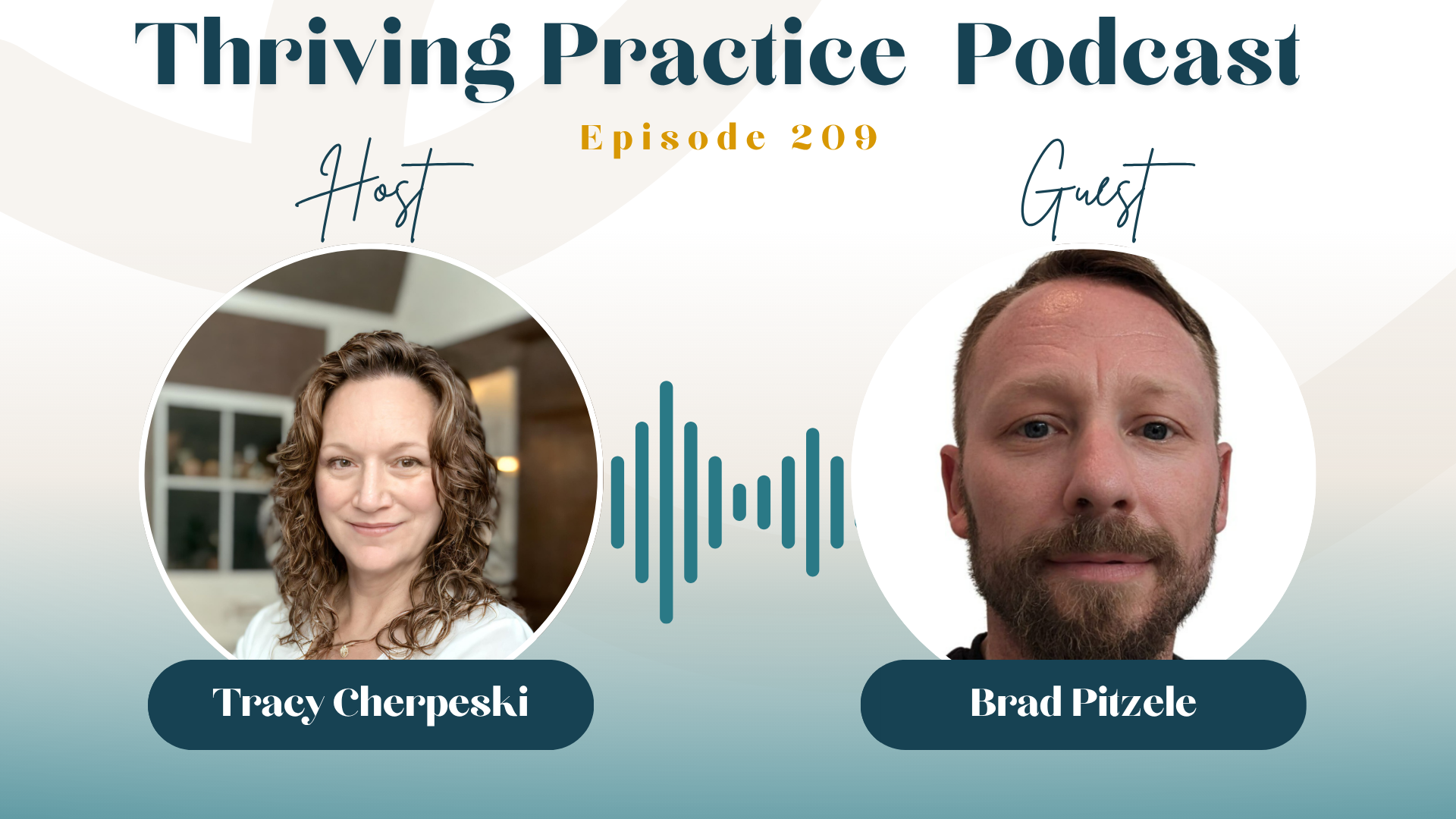
The Oxygen Advantage: Building a Profitable EWOT Practice, Featuring Brad Pitzele, EP 209
In this episode, Brad Pitzele shares his journey from chronic illness survivor to EWOT advocate and business owner. Facing autoimmune issues and Lyme disease that left him struggling with brain fog, pain, and 50+ symptoms, Brad discovered Exercise with Oxygen Therapy when traditional treatments failed. After building his own system and experiencing dramatic improvements, he founded 1000 Roads to make EWOT more accessible. The conversation explores the science behind EWOT, its applications for chronic illness and athletic recovery, and the business case for healthcare providers looking to integrate this therapy into their practices.
In this episode, Brad Pitzele shares his journey from chronic illness survivor to EWOT advocate and business owner. Facing autoimmune issues and Lyme disease that left him struggling with brain fog, pain, and 50+ symptoms, Brad discovered Exercise with Oxygen Therapy when traditional treatments failed. After building his own system and experiencing dramatic improvements, he founded 1000 Roads to make EWOT more accessible. The conversation explores the science behind EWOT, its applications for chronic illness and athletic recovery, and the business case for healthcare providers looking to integrate this therapy into their practices.
Key Highlights:
EWOT uses concentrated oxygen during exercise to improve cellular oxygenation and reduce inflammation
Research dating to the 1960s shows benefits for everything from cancer to autoimmune conditions
Systems start at under $2,500 with quick ROI potential through session-based pricing
Minimal staff oversight required - front office staff can manage patient setup
Effective for chronic illness, athletic recovery, and general wellness applications
Pairs well with other therapies like red light therapy for enhanced benefits
Memorable Quotes: "The hardest part about selling EWOT is that it does so many great things, it's almost like not believable."
"When you do EWOT, you're not just using the red blood cells, you're actually saturating the blood plasma, which is about a thousand times thinner than a red blood cell and can get through those blockages."
"70% of the detoxification that you do in your body is actually through your lungs."
Brad's combination of personal experience and engineering background provides unique insights into both the therapeutic potential and practical implementation of EWOT, making this episode valuable for any healthcare provider exploring innovative treatment modalities.
Find out more about red light therapy and EWOT - exercise with oxygen therapy. Learn more about red light therapy wavelengths.
Brad’s Bio:
Brad Pitzele is the founder of One Thousand Roads and a chronic illness survivor who discovered Exercise with Oxygen Therapy (EWOT) when facing severe autoimmune diseases, chronic fatigue, and cancer. After being unable to afford existing EWOT systems ranging from $5,000-$25,000, Brad used his engineering background to build his own system, experiencing dramatic health improvements that inspired him to launch One Thousand Roads in 2016. The company focuses on providing affordable, high-quality wellness products for people with chronic illnesses, with a mission to help one thousand people recover their health and quality of life. Eight years later, One Thousand Roads has helped thousands of customers on their wellness journeys while making EWOT more accessible through systems starting under $2,500.
Find Brad:
See Where Your Practice Stands: Take our Practice Growth Readiness Assessment
Connect With Us:

The 'Always On' Trap: Why Healthcare Providers Must Learn to Turn Off – A Special Snack Episode, EP 208
Healthcare providers excel at caring for others but often struggle with self-care. In this honest conversation, Tracy Cherpeski shares why the 'always on' mindset is actually counterproductive and reveals practical strategies for breaking free from energy-draining habits.
Healthcare providers excel at caring for others but often struggle with self-care. In this honest conversation, Tracy Cherpeski shares why the 'always on' mindset is actually counterproductive and reveals practical strategies for breaking free from energy-draining habits.
Key Highlights:
Why the word "should" creates unnecessary guilt and obligation
How your well-being directly impacts your team's performance
The danger of checking your phone first thing in the morning
Why email shouldn't be the first task of your day
The 60-day rule for creating lasting habits
Building flexibility into habit formation to avoid perfectionism pitfalls
Memorable Quotes: "Do not should on yourself or others—that word is so laden with judgment."
"If you're not right, ain't nothing right in your business."
"When I'm stressed, I get spacey, and when I'm spacey, that means you have to work harder."
"We need to give ourselves permission to turn it off and to step away. That's really, really, really hard."
This episode offers actionable insights for healthcare providers ready to prioritize their well-being without compromising patient care. Sometimes the best thing you can do for your practice is take better care of yourself.
Is your practice growth-ready? See Where Your Practice Stands: Take our Practice Growth Readiness Assessment
Miranda’s Bio:
Miranda Dorta, B.F.A. (she/her/hers) is the Manager of Operations and PR at Tracy Cherpeski International. A graduate of Savannah College of Art and Design with expertise in writing and creative storytelling, Miranda brings her skills in operations, public relations, and communication strategies to the Thriving Practice community. Based in the City of Oaks, she joined the team in 2021 and has been instrumental in streamlining operations while managing the company's public presence since 2022.
Tracy’s Bio:
Tracy Cherpeski, MBA, MA, CPSC (she/her/hers) is the Founder of Tracy Cherpeski International and Thriving Practice Community. As a Business Consultant and Executive Coach, Tracy helps healthcare practice owners scale their businesses without sacrificing wellbeing. Through strategic planning, leadership development, and mindset mastery, she empowers clients to reclaim their time and reach their potential. Based in Chapel Hill, NC, Tracy serves clients worldwide and is the Executive Producer and Host of the Thriving Practice podcast. Her guiding philosophy: Survival is not enough; life is meant to be celebrated.
Connect With Us:

AI in Healthcare: How Technology Makes Patient Care More Human, Featuring David Herman, EP 207
David Herman from Web Marketing for Dentists joins us to discuss how dental practices can leverage modern marketing strategies while maintaining the human touch that builds lasting patient relationships. With over 20 years in the industry, David shares insights on why traditional marketing principles still work, how AI is enhancing rather than replacing human connections, and why understanding your specific practice goals is crucial for marketing success.
David Herman from Web Marketing for Dentists joins us to discuss how dental practices can leverage modern marketing strategies while maintaining the human touch that builds lasting patient relationships. With over 20 years in the industry, David shares insights on why traditional marketing principles still work, how AI is enhancing rather than replacing human connections, and why understanding your specific practice goals is crucial for marketing success.
Key Highlights:
Why Google and SEO aren't actually dead despite industry claims
How AI phone systems can double appointment bookings while reducing front desk burden
The importance of weekend hours and quick response times for new patient acquisition
Why targeting specific procedures and patient types beats generic "get more patients" approaches
The psychology behind dental patient behavior and decision-making
How to measure marketing ROI and ask better questions of your marketing team
Memorable Quotes: "We thought at the beginning it was money, but it's not. They also like money, but it's definitely secondary to helping people in the way that they feel they can help people the best."
"Google Ads is mind reading for marketers. There is nothing like it... It's the only mind reading marketing service there is."
"Everything that is monotonous and boring in somebody's job, that's the first place that AI should be employed. Because AI doesn't find it monotonous or boring."
David's approach stands out because he focuses on understanding what kind of dental work each practitioner truly enjoys, then tailors marketing efforts to attract those specific cases. Rather than promising overnight results, he emphasizes sustainable growth and measurable outcomes, making him a valuable resource for practices ready to invest thoughtfully in their marketing efforts.
See Where Your Practice Stands: Take our Practice Growth Readiness Assessment
David’s Bio:
David is the Chief Marketing Officer for Web Marketing For Dentists. He holds a Masters in Language & Psycholinguistics from Cambridge University and spent 10 years creating ads for major companies like Procter & Gamble and General Motors before discovering his passion for dental marketing in 2004. Since then, he's worked with over 2,000 dentists across the USA, Canada, and UK, generating more than $30 million in annual production for his clients. His campaigns typically help individual dentists add $10K-100K to their monthly revenue. David leads a team of 30+ dental marketing experts based primarily in Miami, with additional team members across six continents.
Find David:
See Where Your Practice Stands: Take our Practice Growth Readiness Assessment
Connect With Us:
Schedule Strategy Session with Tracy

Women in Medicine Month: Exposing the Research Bias That's Making Burnout Worse, EP 206
Episode Overview: In this powerful solo episode honoring Women in Medicine Month, Tracy Cherpeski exposes a critical flaw in physician burnout research that's been hiding in plain sight. While women now represent the majority of medical students, they face burnout rates nearly 50% higher than men and remain dramatically underrepresented in practice ownership - the very model that offers the autonomy and control that could address their burnout crisis.
Key Highlights:
Major burnout studies systematically exclude private practice owners who report the highest job satisfaction
Women physicians experience 47% burnout rates compared to 39% for men, yet only 34% own their practices
Private practice ownership has declined from 60% to 42% since 2012, eroding the practice model with highest physician satisfaction
Self-employed physicians earn 11% more and cite autonomy as their top priority
The research bias creates policies that favor large health systems while undermining diverse practice models
Memorable Quotes: "It's like studying American happiness but only surveying corporate employees while completely ignoring entrepreneurs and small business owners. Then wondering why everyone seems miserable."
"You're not just building a practice - you're modeling a different way to practice medicine. And that matters more than you might know."
"The solution to physician burnout isn't bigger health systems or more employment. It's empowering physicians to create practices that work for their lives, their values, and their wellbeing."
This episode challenges listeners to see practice ownership not just as a business model, but as a powerful wellbeing strategy that's been overlooked by mainstream medical research.
Tracy’s Bio:
Tracy Cherpeski, MBA, MA, CPSC (she/her/hers) is the Founder of Tracy Cherpeski International and Thriving Practice Community. As a Business Consultant and Executive Coach, Tracy helps healthcare practice owners scale their businesses without sacrificing wellbeing. Through strategic planning, leadership development, and mindset mastery, she empowers clients to reclaim their time and reach their potential. Based in Chapel Hill, NC, Tracy serves clients worldwide and is the Executive Producer and Host of the Thriving Practice podcast. Her guiding philosophy: Survival is not enough; life is meant to be celebrated.
See Where Your Practice Stands: Take our Practice Growth Readiness Assessment
Connect With Us:
Schedule Strategy Session with Tracy
The Gardener's Approach: Growing Your Practice Without Burning Out - A Special Snack Episode, EP 205
In this candid snack episode, Tracy Cherpeski shares insights on developing an entrepreneurial mindset while maintaining clinical excellence. She introduces the concept of "hat switching" between clinical and business roles, explores the gardener's approach to practice growth, and provides practical strategies for expanding revenue without extending work hours.
In this candid snack episode, Tracy Cherpeski shares insights on developing an entrepreneurial mindset while maintaining clinical excellence. She introduces the concept of "hat switching" between clinical and business roles, explores the gardener's approach to practice growth, and provides practical strategies for expanding revenue without extending work hours.
Key Highlights
The importance of switching between "clinician" and "CEO/entrepreneur" hats
How entrepreneurial flexibility complements medical training rigidity
The gardener's approach: planting seeds and practicing detachment from outcomes
Practical revenue stream ideas including mid-level providers, supplement lines, and health coaching partnerships
Why clarity of vision serves as the foundation for sustainable practice growth
Memorable Quotes
"If you're in your clinical mindset and you try to think like an entrepreneur, it crosses some of the lines of duty of care and things like that."
"Sometimes you got to dig through a lot of shit to be able to get to the good stuff."
"Be super, super clear about what it is that you want to achieve... but then we let go of it and we just know that we're likely to get there or maybe better."
Closing
This episode perfectly captures the dynamic between clinical excellence and business savvy that defines thriving practices. Tracy's practical wisdom offers healthcare providers a roadmap for sustainable growth without compromising their core mission of healing.
See Where Your Practice Stands: Take our Practice Growth Readiness Assessment
Miranda’s Bio:
Miranda Dorta, B.F.A. (she/her/hers) is the Manager of Operations and PR at Tracy Cherpeski International. A graduate of Savannah College of Art and Design with expertise in writing and creative storytelling, Miranda brings her skills in operations, public relations, and communication strategies to the Thriving Practice community. Based in the City of Oaks, she joined the team in 2021 and has been instrumental in streamlining operations while managing the company's public presence since 2022.
Tracy’s Bio:
Tracy Cherpeski, MBA, MA, CPSC (she/her/hers) is the Founder of Tracy Cherpeski International and Thriving Practice Community. As a Business Consultant and Executive Coach, Tracy helps healthcare practice owners scale their businesses without sacrificing wellbeing. Through strategic planning, leadership development, and mindset mastery, she empowers clients to reclaim their time and reach their potential. Based in Chapel Hill, NC, Tracy serves clients worldwide and is the Executive Producer and Host of the Thriving Practice podcast. Her guiding philosophy: Survival is not enough; life is meant to be celebrated.
Connect With Us:
Beyond Success: How Two Practice Owners Created Expanding Circles of Influence, EP 204
In this final episode of the mindful leadership series, Tracy Cherpeski explores how internal work creates expanding ripples of success. Following up with Dr. Sarah and Dr. Marcus years after their initial work, we see how their practices have become magnetic centers that naturally attract resources, talent, and opportunities. This episode reveals the five ripple zones that create sustainable competitive advantage and shows how mindful leadership becomes a powerful business strategy.
In this final episode of the mindful leadership series, Tracy Cherpeski explores how internal work creates expanding ripples of success. Following up with Dr. Sarah and Dr. Marcus years after their initial work, we see how their practices have become magnetic centers that naturally attract resources, talent, and opportunities. This episode reveals the five ripple zones that create sustainable competitive advantage and shows how mindful leadership becomes a powerful business strategy.
Key Highlights
How Dr. Sarah now takes three-week unplugged vacations while her team runs seamlessly
Marcus's referral systems that are "crushing it" while he focuses on strategic growth
The five ripple zones that create magnetic pull in healthcare practices
Why pushing for success creates resistance while magnetic leadership creates flow
How internal work compounds into external competitive advantages over time
Memorable Quotes
"The most profitable practices aren't just well-run businesses – they're energy centers that attract everything they need to thrive."
"When you're pushing, you're working against resistance. When you're magnetic, resources flow toward you effortlessly."
"Your mindful leadership isn't just personal development; it's business strategy."
"The question isn't whether you're capable of this level of success – the question is whether you're ready to begin."
This episode demonstrates that sustainable practice success flows from the inside out, showing how two different practitioners used the same framework to create practices that continue thriving and expanding their influence years later.
Tracy’s Bio:
Tracy Cherpeski, MBA, MA, CPSC (she/her/hers) is the Founder of Tracy Cherpeski International and Thriving Practice Community. As a Business Consultant and Executive Coach, Tracy helps healthcare practice owners scale their businesses without sacrificing wellbeing. Through strategic planning, leadership development, and mindset mastery, she empowers clients to reclaim their time and reach their potential. Based in Chapel Hill, NC, Tracy serves clients worldwide and is the Executive Producer and Host of the Thriving Practice podcast. Her guiding philosophy: Survival is not enough; life is meant to be celebrated.
See Where Your Practice Stands: Take our Practice Growth Readiness Assessment
Connect With Us:
From Firefighting to Success Architecture: The 4-Pillar Framework That Scales Healthcare Practices, EP 203
This episode introduces the concept of Success Architecture—the intentional framework that allows healthcare practices to grow predictably and profitably without requiring constant reactive management. Through the compelling case study of Dr. Marcus, Tracy demonstrates how the right foundation can transform a practice from survival mode to sustainable growth, achieving remarkable results in just 90 days.
This episode introduces the concept of Success Architecture—the intentional framework that allows healthcare practices to grow predictably and profitably without requiring constant reactive management. Through the compelling case study of Dr. Marcus, Tracy demonstrates how the right foundation can transform a practice from survival mode to sustainable growth, achieving remarkable results in just 90 days.
Key Highlights
Dr. Marcus increased revenue by 30% while dramatically improving profit margins in 90 days
Reclaimed 20 hours per week through strategic energy management
Achieved 10X ROI within 18 months while adding two new providers
The Four Pillars: Mental Clarity, Energy Management, Systems Thinking, and Abundance Mindset
90-day implementation strategy: Foundation Phase, Construction Phase, Integration Phase
Why most practices fail: building on "sand" instead of solid architecture
The difference between managing your practice and leading your practice
Memorable Quotes
"The difference isn't talent, market conditions, or luck—it's Success Architecture."
"Success Architecture is the difference between reacting to your practice and creating your practice."
"Clarity equals speed."
"Energy management isn't about time management—it's about impact management."
"The practices that will flourish in the next decade will be led by architects, not firefighters."
This episode provides the roadmap for building the solid foundation every successful practice needs. Whether you're feeling stuck in reactive mode or ready to scale strategically, Success Architecture offers the framework to move from chaos to predictable growth. Don't miss next week's finale where we explore how internal transformation creates powerful external impact.
Tracy’s Bio:
Tracy Cherpeski, MBA, MA, CPSC (she/her/hers) is the Founder of Tracy Cherpeski International and Thriving Practice Community. As a Business Consultant and Executive Coach, Tracy helps healthcare practice owners scale their businesses without sacrificing wellbeing. Through strategic planning, leadership development, and mindset mastery, she empowers clients to reclaim their time and reach their potential. Based in Chapel Hill, NC, Tracy serves clients worldwide and is the Executive Producer and Host of the Thriving Practice podcast. Her guiding philosophy: Survival is not enough; life is meant to be celebrated.
See Where Your Practice Stands: Take our Practice Growth Readiness Assessment
Connect With Us:
The $400K Barrier: The One Mindset Shift That Changed Everything, EP 202
Healthcare practice owners often unknowingly create internal barriers that directly impact their bottom line – not from lack of clinical skills or business knowledge, but from deeply embedded beliefs that show up as seemingly logical decisions. Through Dr. Sarah's compelling transformation story, this episode reveals how one practice owner went from working 60+ hour weeks while personally taking patient payments to achieving a 40% revenue increase and reclaiming 20 hours per week, all by dismantling a single invisible barrier.
Healthcare practice owners often unknowingly create internal barriers that directly impact their bottom line – not from lack of clinical skills or business knowledge, but from deeply embedded beliefs that show up as seemingly logical decisions. Through Dr. Sarah's compelling transformation story, this episode reveals how one practice owner went from working 60+ hour weeks while personally taking patient payments to achieving a 40% revenue increase and reclaiming 20 hours per week, all by dismantling a single invisible barrier.
Key Highlights:
How fear-based overhead decisions actually limit revenue capacity
The true cost of operating from a scarcity mindset disguised as quality control
Why equating personal worth with work hours creates success-limiting bottlenecks
A real case study showing 26x ROI from barrier removal
Three practical assessment questions to identify your own hidden barriers
Memorable Quotes: "Your barriers aren't protecting you; they're imprisoning you. And every day you don't address them, you're leaving money on the table and freedom off your calendar."
"Sarah thought she couldn't afford a $40,000 administrative salary, but her barrier was costing her $400,000 in lost revenue."
"They're like having a Ferrari with the emergency brake on. You've got the engine, the capability, the vision – but you're burning fuel while barely moving forward."
This episode launches a three-part series on building what Tracy calls "Success Architecture" – the mindset foundation that allows practices to scale without sacrificing sanity. Perfect for practice owners ready to stop being the emergency brake in their own success story.
Tracy’s Bio:
Tracy Cherpeski, MBA, MA, CPSC (she/her/hers) is the Founder of Tracy Cherpeski International and Thriving Practice Community. As a Business Consultant and Executive Coach, Tracy helps healthcare practice owners scale their businesses without sacrificing wellbeing. Through strategic planning, leadership development, and mindset mastery, she empowers clients to reclaim their time and reach their potential. Based in Chapel Hill, NC, Tracy serves clients worldwide and is the Executive Producer and Host of the Thriving Practice podcast. Her guiding philosophy: Survival is not enough; life is meant to be celebrated.
See Where Your Practice Stands: Take our Practice Growth Readiness Assessment
Connect With Us:
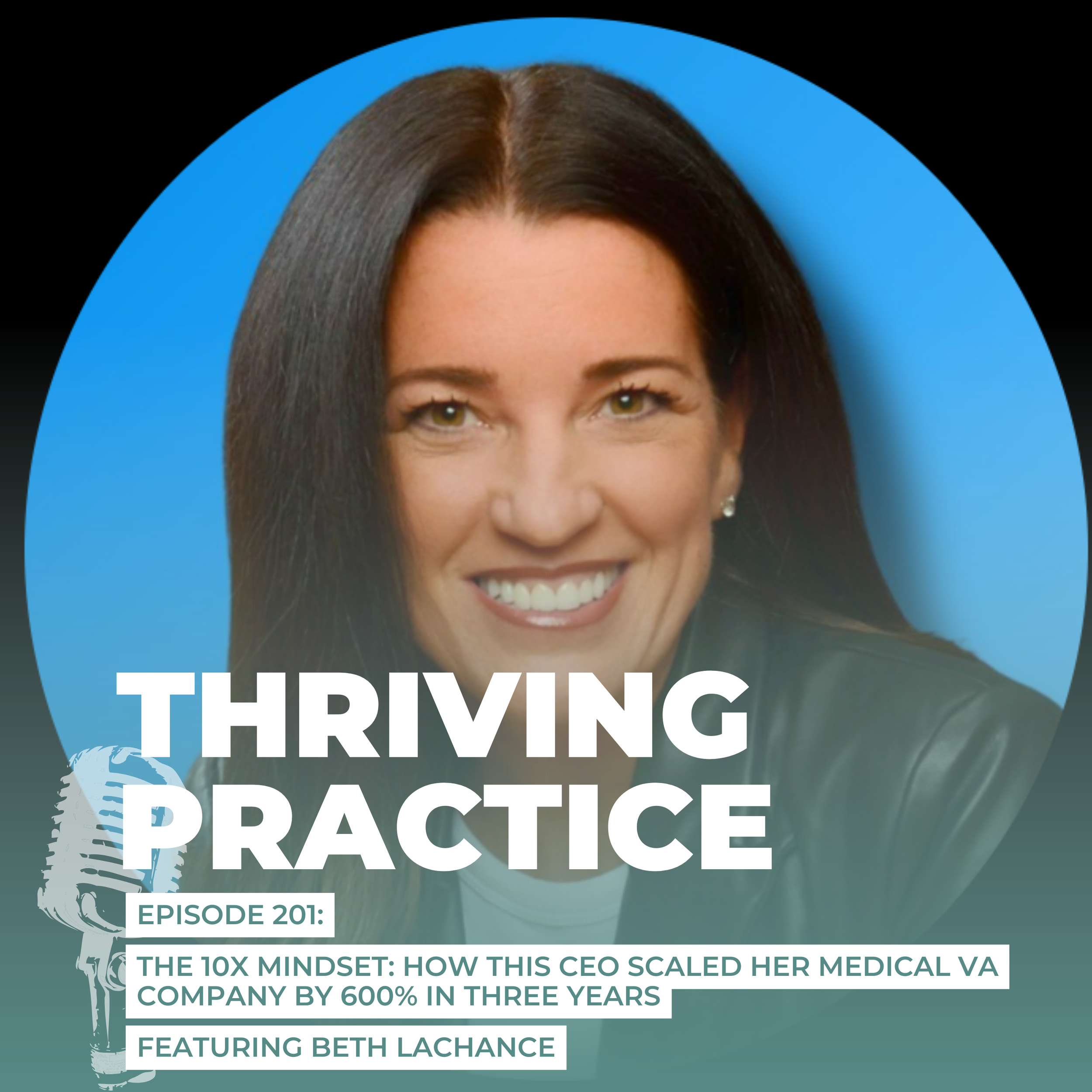
The 10x Mindset: How This CEO Scaled Her Medical VA Company by 600% in Three Years, Featuring Beth Lachance, EP 201
In this episode, Beth explains how medical virtual assistants work as an "insourcing" solution rather than outsourcing, providing practices with HIPAA-compliant professionals who have medical backgrounds and bachelor's degrees. She breaks down the cost-effectiveness of the model ($525 per week per full-time VA), how it improves patient care and staff morale, and why it's suitable for practices of any size.
Beth Lachance has built something remarkable. As the founder and CEO of Global Medical Virtual Assistants, she's scaled her company from around 200 to over 1,350 medical virtual assistants in just three years, all while helping medical practices nationwide solve their biggest challenge: administrative overwhelm.
In this episode, Beth explains how medical virtual assistants work as an "insourcing" solution rather than outsourcing, providing practices with HIPAA-compliant professionals who have medical backgrounds and bachelor's degrees. She breaks down the cost-effectiveness of the model ($525 per week per full-time VA), how it improves patient care and staff morale, and why it's suitable for practices of any size.
Beyond the business model, Beth shares raw insights about scaling a company, including her philosophy of planning for 10x growth instead of 2x to avoid constantly rebuilding infrastructure. She discusses the importance of having the right people in the right seats, embracing mistakes as learning opportunities, and not getting paralyzed by over-analysis.
EPISODE HIGHLIGHTS
How medical virtual assistants create "sufficient support" rather than just basic help
The mindset shift from virtual "assistants" to virtual "professionals"
Why insourcing beats outsourcing for medical practices
Planning for 10x growth instead of 2x to build scalable infrastructure
The cost breakdown: $525/week per full-time medical VA vs. traditional hiring
How proper support systems improve patient reviews and staff retention
Why Beth moved from 200 to 1,350 team members in three years
The importance of cultural fit over high performance in hiring
How administrative burden contributes to physician burnout
MEMORABLE QUOTES
"We are not brought into a medical practice to take jobs that are already in place. We're really brought in as additional support."
"Don't look at what you look like when you double. What do you look like when you 10x? So that you're not reimagining this all over again."
"Don't be afraid to make a mistake. Trial it. If you made a mistake, you just go back to the drawing board and go at it another way."
"They're virtual professionals. They have a bachelor's degree. They are smart. They take initiative. You're minimizing what their level could potentially be when you think 'virtual assistant.'"
"This is insourcing. You are bringing additional staffing into your practice, but remotely."
"If you don't handle even the minutiae, like the little problems, you'll scale them with you."
CLOSING
Whether you're running a solo practice or managing a multi-location operation, Beth's insights remind us that growth doesn't have to come at the expense of quality care or team wellbeing. Sometimes the answer isn't working harder - it's working smarter by building the right support systems from the start.
Bio:
Beth Lachance is the founder and CEO of Global Medical Virtual Assistants, a company that provides HIPAA-compliant virtual staffing solutions to medical practices nationwide. With over 22 years of leadership experience in the surgical device, pharmaceutical, and specialty pharmacy industries, Beth combines deep healthcare knowledge with entrepreneurial expertise to solve administrative overwhelm in medical practices.
A former Division I gymnast at the University of Florida with a Bachelor of Science in Health Sciences, Beth has scaled GMVA from a small team to over 1,350 skilled medical virtual assistants. Her mission is to free healthcare professionals from administrative burden so they can focus on exceptional patient care while building sustainable, thriving practices.
Beth is passionate about empowering women in leadership and driving innovation in healthcare operations.
Find Beth:
See Where Your Practice Stands: Take our Practice Growth Readiness Assessment
Connect With Us:
200 Episodes Deep: Season 9 Kicks Off with New Vision for Healthcare Practices – A Special Snack Episode, EP 200
Episode 200 marks a significant milestone for the Thriving Practice Podcast, celebrating not just the achievement but the entire healthcare community that has grown alongside it. Tracy and Miranda offer an intimate look at how the podcast has evolved, what drives their content decisions, and the exciting changes coming in future episodes. This behind-the-scenes conversation reveals the heart behind the podcast and the movement it has become.
Episode 200 marks a significant milestone for the Thriving Practice Podcast, celebrating not just the achievement but the entire healthcare community that has grown alongside it. Tracy and Miranda offer an intimate look at how the podcast has evolved, what drives their content decisions, and the exciting changes coming in future episodes. This behind-the-scenes conversation reveals the heart behind the podcast and the movement it has become.
Key Highlights:
The podcast's evolution from experimental project to community movement
New content formats including association partnerships and episode series
Introduction of beta sponsorship program to expand reach and production quality
The importance of balancing 10,000-foot strategic vision with actionable implementation
How listener feedback, especially love for "snack episodes," shapes content direction
The democratic nature of the podcast as free, accessible support for all healthcare providers
Memorable Quotes: "Momentum is our friend. We can take our hard earned wisdom and build from that... it feels like a movement."
"From the perspective of above the mountains, nature is doing what it does, and it's handled... nothing can be insurmountable for us."
"This is on demand, it's always going to be free... It's evergreen and it's fully democratic."
Closing: This milestone episode captures the genuine passion driving the Thriving Practice Podcast. As Tracy and Miranda look toward the future, their commitment to serving healthcare providers remains unwavering, with exciting developments that promise to deepen the impact of this thriving community.
Miranda’s Bio:
Miranda Dorta, B.F.A. (she/her/hers) is the Manager of Operations and PR at Tracy Cherpeski International. A graduate of Savannah College of Art and Design with expertise in writing and creative storytelling, Miranda brings her skills in operations, public relations, and communication strategies to the Thriving Practice community. Based in the City of Oaks, she joined the team in 2021 and has been instrumental in streamlining operations while managing the company's public presence since 2022.
Tracy’s Bio:
Tracy Cherpeski, MBA, MA, CPSC (she/her/hers) is the Founder of Tracy Cherpeski International and Thriving Practice Community. As a Business Consultant and Executive Coach, Tracy helps healthcare practice owners scale their businesses without sacrificing wellbeing. Through strategic planning, leadership development, and mindset mastery, she empowers clients to reclaim their time and reach their potential. Based in Chapel Hill, NC, Tracy serves clients worldwide and is the Executive Producer and Host of the Thriving Practice podcast. Her guiding philosophy: Survival is not enough; life is meant to be celebrated.
See Where Your Practice Stands: Take our Practice Growth Readiness Assessment
Connect With Us: